Calculating Your “Real” Grade Point Average (GPA)
Everyone knows the importance of a high school student’s grade point average, or GPA. It’s the little number that labels us. It signifies whether we are a geek or slacker, or somewhere in between. The GPA is usually either a point of great pride or great shame. Those students who are proud of their GPA practically have it tatooed on their foreheads, while others skulk about in fear that someone might discover what ignoramuses they truly are.
In college admission, it serves as a critical litmus tests: how good a student is this person, and will he or she succeed at this college.
No matter how you cut it, the GPA is a source of anxiety and tension for just about everyone.
But let’s be philosophical for a minute. One’s GPA is not a measure of one’s worth as a human being. It is not even a measure of one’s intelligence. Rather, it is the gauge of a young person’s ability to play the game of school. Some tremendously intelligent students completely blow off school (I have several clients of this variety), while some less intelligent students are able, through sheer doggedness and determination, to achieve relatively high GPAs (there are fewer of these, I find).
Calculating one’s GPA is a fairly straightforward process. Except for the fact that many high schools report “weighted” and “unweighted” grade point averages. In a previous post, I detail the differences between a weighted and unweighted GPA. Basically, a weighted GPA takes into account the difficulty of the courses a student is taking, and those taking harder courses are rewarded with extra “brownie points” in their GPA. Usually colleges strip these brownie points from an applicant’s GPA in order to fairly compare one student against another.
But merely stripping away the brownie points is not enough to uncover your real GPA, because in today’s comprehensive high schools, we give grades for just about every class a student takes, including:
- physical education
- performing groups (including theater and all sorts of music)
- high school sports training
- vocational education classes, like shop, auto mechanics, and the like
- health classes, including sexual education
- student aide or school helper
These courses help pad a high school student’s schedule. But they do not constitute the academic core of high school. Grades in these courses do provide a measure of success (I actually have a client who received an “F” as a student aide–I’m hoping that was a clerical error!). But these grades cannot really be counted as a measure of a student’s academic abilities.
Therefore, to calculate a student’s core GPA, we have to remove the fluff. We have to calculate the GPA based solely on the five academic solids that constitute a high school student’s performance:
- Math
- English or Language Arts
- Social Studies
- Science
- Foreign Language
The core GPA is your “real” GPA: this is the measure of your academic performance in high school. (Again, it’s not a measure of self-worth.) Unless students come to me with a transcript with nothing but grades of A, most students are disappointed to see their 3.0 cumulative, weighed GPA fall to a more embarrassing 2.3 or lower. Those gym classes and band classes are not only fun, but they artificially prop up one’s GPA.
And colleges know it. So those with relatively selective admissions processes will strip the fluff right out of the GPA in order to get down to brass tacks: how well does this particular student perform in academic work?
So, while I hate to be the bearer of bad news, I encourage students from middle school onward to be aware of their “real” GPA as they go through school, and to not be blinded by the number printed on the grade report. They need to be aware that some courses, whether required (health, gym) or not (jazz band, sports conditioning) may artificially inflate their cumulative GPA, and may lead to academic complacency.
The lesson: don’t let yourself be deluded by the numbers on the page. College admissions officers, who must compare one student against another in deciding whom to admit, will strip your GPA of all non-academic fluff. Don’t wait until the fall of your senior year to come to the realization that your GPA may be artificially inflated.
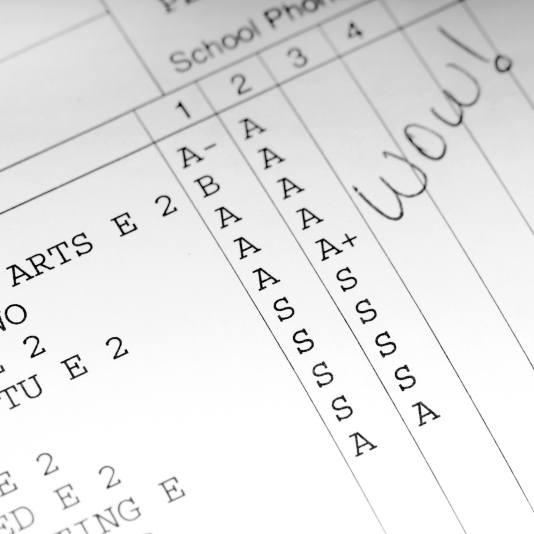
So throw off the rose-colored classes, strip your GPA of all artificial weighting, and strike out all those A grades you received in those electives you love. Ultimately, your “real” GPA is what colleges will consider most carefully.
Now with that out of the way, let’s look at the nuts and bolts of the GPA calculation for students who are awarded letter grades. For each grade in an academic course, assign the following number values to each grade. Then simply divide the sum of these numbers by the number of courses (a simply average). This will be our “Real” GPA.
A = 4.0
A- = 3.7
B+ = 3.3
B = 3.0
B- = 2.7
C+ = 2.3
C = 2.0
C- = 1.7
D+ = 1.3
D = 1.0
F = 0
So, to give an example, let’s say that Stan the Student has a B- in Math, a B+ in English, a C+ in social studies, an A in Spanish, and a B in science, we add the following values: 2.7 + 3.3 + 2.3 + 4.0 + 3.0, for a total of 15.3. Divide by 5 course, and the GPA is 3.06.
Also, you may want to get an idea of how to translate percentages into the numerical grade point average.
Mark Montgomery
College Counselor and
Bearer of Bad News
Technorati Tags: GPA, grade point average, college admission, college entrance, academic Del.icio.us Tags: GPA, grade point average, college admission, college entrance, academic
21 Responses to “Calculating Your “Real” Grade Point Average (GPA)”
Leave a Reply
- Weighted or Unweighted GPA?
- Calculating Your "Real" Grade Point Average (GPA)
- Six Tips For Getting Great Letters of Recommendation For College
- How Good are Advanced Placement (AP) Courses? Are They Worth Taking?
- Class Size and Student-to-Faculty Ratios: What the Statistics Don't Tell You
- Division I vs. Division III: Sports as a Job, or Scholar-Athlete?
- College Fit: How Does the Shirt Look on Me?
- Quality of the Educational Experience: Questions to Ask Admissions Officers
- SAT Will Allow Students To Submit Best Scores To Colleges
- School's Out! Top 10 Summertime Tips for College Admission
- January 2009
- December 2008
- November 2008
- October 2008
- September 2008
- August 2008
- July 2008
- June 2008
- May 2008
- April 2008
- March 2008
- February 2008
- January 2008
- December 2007
- November 2007
- October 2007
- September 2007
- August 2007


What is the point of this article? It doesn’t even tell you how to calculate your “real” GPA. Give it a relative title.
Hello, Ann, and thanks for visiting my blog. I still think my title is relevant (*was that the word you were seeking?), because I do explain how colleges perceive your GPA. Perhaps I was not clear enough, but I think I do indicate that to calculate your “real” GPA, you need to
1. Focus on core academic subjects
2. Cut out all non-academic subjects from the average
3. Eliminate all artificial weightings high schools may create to award honors courses more points in the GPA.
If I can be more specific in helping you calculate your “real” GPA, please let me know. And again, thanks for visiting!
dude, put down HOW to calculate your GPA that would be way more helpful than just saying how colleges see your GPA
Lab,
Thanks for the comment and the suggestion. Since you and Ann have mad the same suggestion, I have appended the post to give you tips on how to do the simple calculation. Just give every letter grade the appropriate number value, then divide the sum of those numbers by the total number of courses you have taken. Again, remember to use only the academic core courses in making this calculation.
Hope this helps. Thanks again for stopping by and suggesting ways I can improve this post.
[...] PS: You might want to look at my post on how to calculate your “real” GPA. [...]
[...] of my most popular posts is about how to calculate your “real” GPA. Some readers have asked how to translate grades expressed as a percent into letter grades, and [...]
I attend a high school in Loudoun County which has a 7 point grading scale, so the lowest A is a 93. Also AP courses are awarded only an additional .7 to the course. I find that this really hurts my GPA. Will the colleges understand the difference?
My Highschool grading scale.
A+ 98-100
A 93-97
B+ 90-92
B 85-89
C+ 82-84
C 77-81
D+ 74-76
D 70-73
F 0-69
Arielle,
Thanks for visiting. First off, thanks for sharing your grading scale at your school. It demonstrates that different schools use different scales. I have used your scale in the past, too, and in some ways I like it better.
But never mind what I like.
Your question is whether schools will understand the difference. Answer: absolutely. They will receive a “high school profile” with your transcript, which will help admissions officers “translate” your grades, GPA, class rank, and all other data into “news they can use.” This will help them interpret your scores so that they can make useful comparisons.
The bottom line for all readers is this: colleges are accustomed to this sort of inconsistency among schools. They do their best to correct for the differences.
Also please remember that admissions is more art than science: colleges rarely have “cut offs” or minimum or maximum anything. With the exception of large state universities where legislation may determine eligibility for admission, most colleges have a holistic approach to reading your application.
Thanks again, Arielle. Very helpful information, and I hope I was able to set your mind at ease. Loudoun County, in particular, is plenty big enough that most colleges in the US will be familiar with your district and its schools.
Best of luck!
I don’t understand why you say that honors and advanced placment courses do not carry more weight in the GPA. These classes are clearly more difficult and the students GPAs should reflect it. According to your interpretation, an 83 in AP English is the same as an 83 in college level. I don’t understand your logic.
Joe,
Thanks for visiting. I understand your confusion, I think. Keep in mind that I am talking about college admission. The issue for college admission is that each school district in the country calculates a GPA differently. Some give extra weight to honors courses, and then even more weight to AP courses or IB courses. Some IB schools give added weight only to the IB diploma courses in 11th and 12th grade, while other weight the “pre-IB” courses of 9th and 10th, too. Some weight only AP courses. Some do not weight anything at all.
So in this land of chaos, how do colleges compare apples to apples.
1. They look at the raw GPA. This is what this post is about.
2. They look at class rank–within the context of the number of students in the graduating class. Here, clearly, weightings are important in determining class rank.
3. They look at the rigor of the curriculum the student has taken. Some colleges may even “score” this rigor, eyeballing it on a scale of 1 to 5, perhaps.
Rest assured that the rigor of the student’s curriculum is very much taken into account in the admissions process.
But the reported GPA of the high school may not be the way that rigor is best reflected. It would not be fair, for example, to compare a student who took 7 AP courses with a 3.7 GPA from a school that did not weight AP courses with a student with a 4.2 GPA of a student with identical numbers of AP courses in a school that did give extra weight to those same AP courses. The first student probably earned more A grades than the second student (who got “bonus points) for those Bs.
I hope this makes sense. My logic is that while weights may be useful to compare students *within* a particular school, weights are often stripped by admissions offices so that they can better compare students from one school (or district or state) to the next.
Seems I should write a post about class rank next!
Again, thanks for stopping by and commenting, and please let me know if I can be of any further assistance.
I am preparing the transcript for my home schooled student who will graduate from high school with about 63 dual enrollment credits that she has taken directly at the community college. Is it worth weighting the grades to calculate her GPA for her transcript. It will be obvious that they are advanced courses already, compared to those of high school (we will request official transcript from the community college).
Dear Olimpia,
Thanks or visiting my blog. Personally, I see no reason for you to assign weights to your student. Colleges are becoming fairly accustomed to seeing transcripts from home schooled students. They will pay most attention the the dual enrollment credits, and the official transcript from the community college. Your assigning weights will seem, in my opinion, rather arbitrary. The community college transcript, though, will clearly communicate your student’s ability to do college work. This is what they want to know: can your student do college work at a high level? The GPA you devise will tell them very little. The grades in the dual enrollment courses–plus whatever SAT II scores the student has taken in addition to the SAT I and ACT–will give the college a way to compare your student with the rest of their applicant pool.
I hope this is helpful. I would also suggest that you get into contact with whatever colleges your student is applying and make sure you understand their procedures for handling home schooled transcripts and applications.
Best of luck!
A very special thank you for your answer.
If my school includes trimester grades on the transcript, do the colleges use these or end of year grades? Would my senior year 1st trimester be counted as my senior end of year grades or will they be weighted as a single trimester or will they not be calculated in my gpa at all? Sorry if that wasn’t clear
Thank you!
Hello, and thanks for your question.
And it’s a good one. But I don’t think I can answer it; you will have to talk to your school counselors to learn how they calculate the GPA. As you point out, it is possible they calculate GPA only on the basis of end-of-year grades, or they might include each trimester. Colleges will see whatever is put onto the transcript, and as I have pointed out elsewhere, colleges will interpret (or reinterpret) to suit their priorities. You high school will send a “school profile” sheet or brochure that will explain your school’s grading system in more detail.
So if you want to understand the details of how your school calculates your GPA, you need to have a chat with the counseling office, and perhaps get a copy of that school profile. This way you’ll at least know how your school will be saying with regard to your own GPA.
I hope this helps. Good luck!
According to what you have written colleges only consider core academic classes when calculating a GPA. What do colleges do when a student has academic electives? For example, I am on the math team at my high school and we take an extra math course freshman, sophomore, and senior year. These are actually math courses that the entire state uses as transition courses (such as Advanced Topics in Mathematics between Algebra 2 and Pre-Calculus). My school apears to be the only one that offers them to give a double period of math instead of an additional seperate option as a math course for people who feel that they are too weak to continue to the next course. Another good example is that next year I am going to take AP Psychology and possibly AP European History which count as academic elective credits at my high school. Additionally, some of the vocational classes also count as academic classes such as the Business Supervison Program (I am also considering taken a few courses here). How would a college calculate a GPA when considering academic electives?
Jesus,
Thanks for visiting, and for your question.
Rest assured that colleges will take into account all your academic electives. If you are like a small minority of students taking more than five solid academic subjects per semester, then you are setting yourself up to be very competitive for selective colleges.
My post here is to remind all students that non-academic electives are not treated in the same way as academic courses. If you are adding to the rigor of your academic load by taking more academic courses, then good for you! And know that college admissions officers will definitely take note of your efforts.
Now all you need to do is get an ‘A’ in each of those courses, and you’ll be all set!
Best of luck!
So far I have straight A’s. Hopefully I can keep it up at least until the impossible Junior Year (AP U.S. History is the class where the teacher won’t let anyone have an A w/o suffering).
P.S. The State Universitry System in my state does weigh classes but at their discretion and not the schools. My school would weigh Honors and AP courses each 1 full point while most universities in the state weigh Honors 0.5 and AP 1 point. They just take the raw GPA and calculate their own weighting.
My daughter’s school does weigh their classes, so we are trying to figure out what the unweighted GPA would be. My question is…
You have given a point value for each letter grade. Not all school districts grade on the same scale. some use 95 and up for an a, some use 93 and up for an a, and some use 90 and up. Can you list the guidelines numerically instead of alphabetically?
Also, my daughter can feel the pain of the previuos poster. Her AP US teacher also would not give out A’s, so my daughter ended up with an 89 in the class,(one of the highest grades) yet made a 5 on the AP test…
Maureen,
Thanks for your comment.
There is, unfortunately, no common grading school across the United States. You will likely only be able to do a rough approximation. Please do not sweat this so much. A couple of points either way will not be the determining factor in your daughter’s application–too much else is in play.
As for the AP US History, the score on the exam will speak more loudly than the grade. Is your daughter considering getting a letter of recommendation from her AP US history teacher? He might say something about his (silly) policy in his letter.
Hope this helps. Let me know if you need anything else.