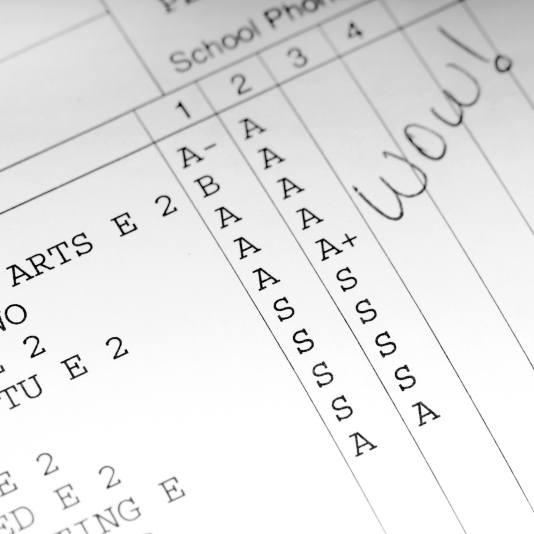
How Do I Calculate My "Real" GPA?

Please share!
    Please share!

      Everyone knows the importance of a high school student’s grade point average, or GPA. It’s the little number that labels us. It signifies whether we are a geek or slacker, or somewhere in between. The GPA is usually either a point of great pride or great shame. Those students who are proud of their GPA practically have it tattooed on their foreheads, while others skulk about in fear that someone might discover what ignoramuses they truly are.GPA good students

      In college admission, it serves as a critical litmus tests: how good a student is this person, and will he or she succeed at this college.

      No matter how you cut it, the GPA is a source of anxiety and tension for just about everyone.

      But let’s be philosophical for a minute. One’s GPA is not a measure of one’s worth as a human being. It is not even a measure of one’s intelligence. Rather, it is the gauge of a young person’s ability to play the game of school. Some tremendously intelligent students completely blow off school (I have several clients of this variety), while some less intelligent students are able, through sheer doggedness and determination, to achieve relatively high GPAs (there are fewer of these, I find).

      Calculating one’s GPA is a fairly straightforward process. Except for the fact that many high schools report “weighted” and “unweighted” grade point averages. In a previous post, I detail the differences between a weighted and unweighted GPA. Basically, a weighted GPA takes into account the difficulty of the courses a student is taking, and those taking harder courses are rewarded with extra “brownie points” in their GPA. Usually colleges strip these brownie points from an applicant’s GPA in order to fairly compare one student against another.

      But merely stripping away the brownie points is not enough to uncover your real GPA, because in today’s comprehensive high schools, we give grades for just about every class a student takes, including:

      • physical education
      • performing groups (including theater and all sorts of music)
      • high school sports training
      • vocational education classes, like shop, auto mechanics, and the like
      • health classes, including sexual education
      • student aide or school helper

      These courses help pad a high school student’s schedule. But they do not constitute the academic core of high school. Grades in these courses do provide a measure of success (I actually have a client who received an “F” as a student aide–I’m hoping that was a clerical error!). But these grades cannot really be counted as a measure of a student’s academic abilities.

      Therefore, to calculate a student’s core GPA, we have to remove the fluff. We have to calculate the GPA based solely on the five academic solids that constitute a high school student’s performance:

      • Math
      • English or Language Arts
      • Social Studies
      • Science
      • Foreign Language

      The core GPA is your “real” GPA: this is the measure of your academic performance in high school. (Again, it’s not a measure of self-worth.) Unless students come to me with a transcript with nothing but grades of A, most students are disappointed to see their 3.0 cumulative, weighed GPA fall to a more embarrassing 2.3 or lower. Those gym classes and band classes are not only fun, but they artificially prop up one’s GPA.

      Battered GPAAnd colleges know it. So those with relatively selective admissions processes will strip the fluff right out of the GPA in order to get down to brass tacks: how well does this particular student perform in academic work?

      So, while I hate to be the bearer of bad news, I encourage students from middle school onward to be aware of their “real” GPA as they go through school, and to not be blinded by the number printed on the grade report. They need to be aware that some courses, whether required (health, gym) or not (jazz band, sports conditioning) may artificially inflate their cumulative GPA, and may lead to academic complacency.

      The lesson: don’t let yourself be deluded by the numbers on the page. College admissions officers, who must compare one student against another in deciding whom to admit, will strip your GPA of all non-academic fluff. Don’t wait until the fall of your senior year to come to the realization that your GPA may be artificially inflated.

      So throw off the rose-colored classes, strip your GPA of all artificial weighting, and strike out all those A grades you received in those electives you love. Ultimately, your “real” GPA is what colleges will consider most carefully.

      Now with that out of the way, let’s look at the nuts and bolts of the GPA calculation for students who are awarded letter grades.  For each grade in an academic course, assign the following number values to each grade.  Then simply divide the sum of these numbers by the number of courses (a simply average). This will be our “Real” GPA.


      A  = 4.0

      A- = 3.7

      B+ = 3.3

      B    = 3.0

      B-  = 2.7

      C+ = 2.3

      C   = 2.0

      C- = 1.7

      D+ = 1.3

      D  = 1.0

      F = 0


      So, to give an example, let’s say that Stan the Student has a B- in Math, a B+ in English, a C+ in social studies, an A in Spanish, and a B in science, we add the following values:  2.7 + 3.3 + 2.3 + 4.0 + 3.0, for a total of 15.3.  Divide by 5 course, and the GPA is 3.06.


      Also, you may want to get an idea of how to translate percentages into the numerical grade point average.


      Mark Montgomery
      College Counselor and
      Bearer of Bad News

      Technorati Tags: Del.icio.us Tags:

      Please share!
        Please share!

          About the Author

          Mark Montgomery

          As a former professor, administrator, and high school teacher, Mark has the knowledge and skills to counsel students as they make the transition from high school to college.

          352 Responses to “How Do I Calculate My "Real" GPA?”

          1. Mark says:

            Hi, Rohan. Thanks for your questions. I find it really frustrating that high schools across the US do not adopt a standard grading system. Obviously, you do, too. I have two pieces of advice. First, talk to your college counselors or guidance counselors and ask about how they “translate” GPAs at their schools for college. Second, call up UNC (or email) and ask if they are accustomed to dealing with your HS, and how they “translate” GPAs from your high school. That’s what I would do, anyway. Sometimes high schools are completely crazy in the way they report grades. I think yours falls into the crazy category.
            Best of luck.

          2. beth says:

            Hi , do dual enrollment classes directly effect your GPA ?

          3. Mark says:

            Hi again.
            Dual enrollment classes will affect your GPA if you get high school credit for them. For complete clarification, talk to your guidance counselor at your school, or consult the school policy manual. All these policies will have been voted upon by the school board or school committee, so it should be part of the public record.
            Hope that helps!

          4. Jonathan says:

            Hey I have a 3.99 GPA (weighted) and a 3.89 (weighted), but after stripping away all the fluff and extra points added by honors and AP, I have about a 3.15 GPA.

            That Sucks.

            I mean its not HORRIBLE, but it will make it so much harder to get into prestigous universities even with a 2300 SAT Score.

          5. Morgan says:

            Ugh. I am a 7th grader with a 3.2 GPA.

          6. Tara Prescott says:

            Hi Mark,
            so my freshmen year i got all B’s and C’s and made a GPA of 2.9. My Sophmore year I did so much better and got a GPA of 3.3. My Junior year I am doing a not to good job, but i am taking AP classes so i suspect my GPA will be a 2.9 again. What do I need to do to show future college people that i will succeed in their college if my GPA is not as good as i want it to be?
            sincerely,
            Tara

          7. Mark says:

            Tara,
            Thanks for visiting. The primary predictor of success in college is your transcript. There is no substitute for hard work and academic achievement. Much will depend on how well you do on these exams, however, including the AP and the SAT or ACT. Sometimes if admissions officers see an inconsistency (success by some measures, not-so-much success in other), they will investigate further. Also, teacher recommendations will likely play a large role for students where such an inconsistency is evident.
            I hope this helps. Good luck.

          8. Mark says:

            Hi, Jonathan. You’re right, this is not “horrible,” but it’s good to be clear on how colleges examine your GPA before you begin the college search. Best of luck.

          9. desiree says:

            i would like to know how can i raise my SAT scores. Any tips or programs would greatly help.

          10. Cristian says:

            Hey, Mark. I have a similar story to that of Tara that has me looking at a 3.03 GPA at the moment. Its kind of upsetting you know that I have been so lazy because I could have easily done better. But regardless of that, I am not taking an AP class this year but next year, senior year, I am going to be taking AP Chem because I want to pursue a career in that field. Also I do have a leadership role as VP of class council and have upheld that position since freshman year, and I am involved in about two other clubs and I am also a part of 2 programs in my school that are very selective: Peer Leadership and Save a Brave. I am also second generation Hispanic, so do you think I have a shot at making to lets say Rutgers?

            Sincerely,
            Cristian

            p.s. I know I wrote and essay ha but I am just really curious and stressed out.

          11. Mark says:

            Hi, Christian,
            Thanks for writing. It sounds like you are doing a lot of things to make your high school experience productive. I can’t give you the sort of “odds” you seek, but I can just remind you of what you already know: your transcript is the most important aspect of your college application. So taking AP classes is a good idea, and doing well in all your classes is going to propel you toward success in whatever college has the good sense to accept you.
            Good luck, and try not to be stressed out!

          12. Mark says:

            Hello, Desiree. I recommend that students prepare first by using the “official” prep books, which you can find on the website here under resources. Second, if you’re looking for a tutor, I may be able to help you find one, depending on where you live. Finally, there is one online organization that helps you prepare that I recommend to students who are disciplined and who want a refresher in the content of the tests. The company is called EPrep, and you can find them at http://eprep.com. If you like what you see on their website, let me know. As an educational consultant, am able to get you a discount off their services.

            I hope this is helpful. Best of luck.

          13. Joshi says:

            Hello Mark:

            I am taking Algebra II at a local community college/ I will then take Algebra II honors in high school in my 10th grade. Since my school does not add outside courses to my transcript how is my true GPA calculated when I apply to college?

            Thanks

          14. Mark says:

            Hi, Joshi. In this case, it will depend a bit upon the colleges to which you apply, but in all cases, having taking this community college course is an asset. It shows you are a serious student and that you are interested in pushing yourself as hard as you can. Colleges love to see this sort of serious attitude toward academics. As for calculating your GPA, different colleges will approach this somewhat differently. But assuming you did well in Algebra I in community college, most will want to give you the benefit of having made this extra effort, and will likely factor the grade from the community college into the overall GPA. So make sure you send the community college transcript in with your application, and find a place in the application to explain that this course was not included in your official high school GPA or credit count.

            I hope this is helpful. Please let me know if I can be of further assistance.

          15. Max says:

            Hello Mark

            I have a 3.6 gpa, now what is that in terms of percentages? This is also my freshman year, so honestly how well have I started off?

          16. Mark says:

            Hi, Max. I’m not sure you need to know how your GPA translates into “percentages.” What appears on your grade report and transcripts? Usually for schools using a 4-point scale, only the grades and their numerical equivalents show up, so that’s all you need to worry about. If you really want to do the math, I’m sure you can figure this out with simple algebra.

            As for how well you have started off, I really can’t say without a lot more information, such as what classes you are taking, where you got the various grades, and what path you are pursuing for your educational future. A 3.6 is on the borderline between an A- and a B+. Are you satisfied with that? Does this grade reflect your best effort and ability? Can you improve? Where can these improvements be made? These are questions that you can better answer than I.

            Thanks for dropping by, and don’t hesitate to ask more questions!

          17. lola says:

            At my school, gpa’s are calculated as follows:

            A+, A, A-=4.0
            B+, B, B-=3.0
            etc., etc.

            I was just wondeirng, when a selective school sees a GPA of 4.0, but there are some A-s on the transcript, will they try to recalculate the gpa with the

            A=4.0
            A-=3.7
            etc., etc. scale?

            Thanks in advance for your answer! :)

          18. Mark says:

            Hello, Lola.
            As regular readers will tell you, then answer is, “it depends.” The more selective the college or university, the more likely they will be to recalculate the GPA. But it also depends on how familiar the admissions office is with your high school. Admissions counselors will evaluate your transcript in the context in which you go to school–inasmuch as they are able. The thing about GPAs is that they provide a semblance of scientific certainty in all this. But the process is more art than science. Bottom line: go for the solid A and the B+ rather than the A- and the solid B. Always better to do better, right?

            Oh, and don’t forget about the idea of learning something!

            Thanks again for stopping by!

          19. Jugia says:

            Are you suggesting that students should not take honors/AP classes because it will not have any value to colleges when applying? In other words, are you saying take standard level courses to get an easy “A” because that’s what a college will look at?

          20. Mark says:

            Hello, Jugia,
            I’m not sure how you drew this conclusion, but the answer is emphatically no: I am *not* suggesting that honors and AP have no value when applying to college. I am *not* saying that students should get the easy A.

            Quite the contrary. The bottom line is that all student, regardless of their academic ambitions, should take the most challenging courses available in which they can succeed. If a student aspires to the most competitive colleges in the land, of course that student should take the most rigorous curriculum possible…and get great grades in those courses.

            There is no short-cut.

            Thanks for dropping by and for asking me to clarify.

          21. Eric says:

            Hello Mark,

            When UC colleges refer to average high school GPA, would they consider freshman and senior year grades when viewing the transcripts too? Most people say they will basically just look at sophomore and junior year grades, but maybe they’d look at more than just those?
            Also, how do they look at summer school grades and consider them as part of the overall high school GPA?
            Thanks!

          22. alex says:

            My dream is too get into UCLA, what do you think i should be doing?

          23. Mark says:

            Hi, Alex.

            Two quick answers:

            1: Live in California.
            2: Get excellent grades in very tough high school classes.

            But seriously, I cannot really tailor any advice to you personally without knowing more about you. All questions students have about college really start and end with the student–and not with the college. So I’d have to get to know you and work with you for a while before I could give you any more than the standard answers that you’ve heard before.

            Let me know if you’d like to explore the possibility of providing you more personalized assistance.

            Thanks for stopping by, and good luck!

          24. Mark says:

            Hi, Eric.

            I don’t know who “most people” are, but all colleges, and especially the UC colleges, are looking at all your grades. All of them. Including summer school, assuming those appear on your transcript.

            In other words, your transcript is that dreaded “permanent record” that adults talk about. It will follow you until you are safely ensconced in an institution of higher learning. Until then, discount nothing that appears on this short, but very powerful document.

            Of course, if there are extenuating circumstances that explain poor performance in your 9th grade year, then perhaps that explanation can appear somewhere in your application. But the UC app offers precious few places to do that sort of thing. And senior grades will definitely be important–all colleges will ask to see those, and usually will not make a decision without them.

            Good luck, and let me know if I can be of further assistance!

          25. MIchael says:

            If u drop a full year class half way through the year, like a foreign language, is that class counted in your GPA?

          26. Mark says:

            Only the classes you take and for which you receive credit will be counted in your GPA. But make sure you are calculating your “real” GPA.

            Hope that helps. Where are you from, Michael?

          27. Eric says:

            Hey Mark, I was wondering about a few things pertaining to calculating GPA:

            Do colleges consider weighted or unweighted GPA when deciding who to admit? I found out on a college data list that the UC colleges consider the weighted GPA.

            When calculating the GPA, do colleges apply the scale with number values such as 3.7 for an A-, a 3.3 for a B+, or just simply four points for any A (e.g. A+, A, A-) and three points for any B(B+, B, B-)?

            For summer school, if I got an A and a B as the grades, what would the GPA be since the seven weeks spent in summer school is similar to a whole year on the subject taken?

            Thanks, Mark. I feel your advce is really helping me learn more since I will be starting the college application sometime this summer

          28. shawn says:

            can a teacher in calif change the grading system for their class to say that 94-100% is an A and 84-93% is a B and 74-83% is a C and 64-73 is a D and 63 and below is failing? Changing the grading system like this also change the gpa…and thus does not seem to be apples to apples for how another class may rate a student. My daughter has struggled in her geometry class. She has a 70 and her teacher told her she has a D. This definitely changes her GPA. If she was in a different geometry class, she would have a C-. Does a California teacher have the power to change the grading system for their class?

          29. Mark says:

            Hello, Shawn. Thanks for your interesting question. I think the answer is best sought from your school district. While each state is somewhat different in the amount of meddling in classroom practices, districts set grading policies. Within those policies, teachers may or may not have leeway in setting their own grading system. I know that in most Colorado districts, not only does each classroom teacher have different grading practices, but they may also use different tests, assign different homework, and use completely different teaching methods.

            But here’s the rub. Actually, there are two rubs.

            First, grading is not a science. Ever. Never has been. Never will be. So while you’re looking at a difference between a 70% and 73%, my question is—70% of what? Of course, the answer is, “70% of points possible.” But what does the “points possible” have to do with the amount of geometry learned? The dirty little secret is that while all teachers (myself included) try to establish a fair, scientific, transparent grading scale, the fact is we mess with the numbers all the time. Or, if we don’t, we are just deluding ourselves about the unscientific nature of the grading process.

            Second, there is a movement afoot to create “standards based” grades, that clearly define the learning outcomes required, and to measure a student’s performance (or give a grade) based on whether they have mastered the concepts and skills. A full implementation of this idea would cause a revolution in high schools, where kids now get “points” for turning in homework–and sometimes just for showing up to class. We thus have a situation in which it is common to find that students get 100% on the homework but fail the test. If students fail the test, then we might logically assume that they didn’t really learn and assimilate the material into their brains. Of course some kids are “bad test takers” (so they say), but some kids rely too heavily on the daily churn of homework that they forget to actually learn anything. Teacher, too, are guilty of focusing on the wrong things: they give the homework points, see lots of kids getting 100%, and then are “shocked” when their students fail the tests. If we paid more attention to actual learning and proficiency and less attention to inane homework assignments, we might actually be able to compare apples to apples. Or at least we’d be stepping in the right direction.

            But in the meantime, Shawn, if you’re looking for “fairness” in American education, or if you believe that we can somehow compare apples to apples across classrooms, across schools, across districts, across states…well, dream on.

            So without strict national or state grading guidelines, all we can say is that your daughter’s grade is an impressionistic measure of how well your daughter stacks up against her peers in the same geometry class. No matter what numbers the different teachers in your school are using, if they use different tests, assign different homework, and teach differently, there is absolutely no way to ascertain whether your daughter would be getting a C or a D under a different numerical grading system. I know we all want “apples to apples” comparisons. But as I say…a pipe dream as long as we have 50 states and 14,000 school districts in this country. I know a lot of people–especially teachers–hate the “standards” movement in K-12 education. But without them, we will always be comparing apples to kumquats to endive to radishes.

            All that said, it seems to me that your focus on different grading systems misses the point. I’d pay less attention to the numbers, and more attention to your daughter’s learning. Whether a 70% counts as a C or a D, she seems to be learning a lot less than the students with a 95%. How could she be learning more?

            I hope this is helpful . Thanks for stopping by.

          30. shawn says:

            Hi Mark, thanks for your speedy reply. I appreciate all of the great info and wisdom you passed onto me. I agree with your last comment…about how much has she really learned if her grade is a C. My issue is a C is considered average. She is not an average student in any of her other classes. She is above average. (A’s and B’s) Geometry is not a subject that she will need to be highly proficient in for her future career. (which is in writing and art)So with that said for her to have to repeat the course whenin essence she is average seems wrong. She now cannot take chemistry until she retakes geometry. So the domino effect now prevents her from also taking algebra II. Just as you say, nothing is perfect…I am just frustrated. Thanks again for your reply.

          31. Eric says:

            Hi Mark,
            My school counselor just sent a form requesting a class called “College Knowledge” in which seniors could get a head start on their college apps and personal statements and get it done before the end of 2009. The only conflict is that I have to give up a selected class in exchange for this one.
            Do you think I should check it out or just stick with the classes that I already have?
            Thanks!

          32. Isabella says:

            Hi mark,
            I have a a question that is sort of off topic. Is my choir teacher allowed to lower my grade because of an unexcused absense to an after-school concert? How much would my grade for the class and my gpa lower?
            Thank you!

          33. Mark says:

            Hello, Isabella. Thanks for the question.

            Of course your teacher is “allowed” to lower your grade because of an unexcused absence to a concert for which you spent the entire term preparing. This is the performance assessment. As with any other course, your grade depends on how well you perform. You didn’t perform–you missed the equivalent of the final exam. So it’s absolutely no surprise that your grade plummeted. If I had been your choir teacher, I would have done exactly the same thing.

            As for how much this will lower your GPA, I cannot calculate that because I don’t know the rest of your grades. But if you do a bit of math, I’m sure you’ll be able to figure it out.

            Thanks for reading my blog and for asking your question. I’m sorry it’s not the answer you may have hoped for, but perhaps it’s the one you need to hear.

          34. Chloe says:

            Hello, I know that grades are important, but I’m doing very well in terms of grades, leadership, and extracurricular activities.
            However, I’m worried about teacher/ guidance recommendations and my AP scores. I don’t feel comfortable sending in AP scores that are not 5′s, so should I refrain from sending any of my AP scores to colleges? How will the college see that action as (since I clearly took the AP courses)?
            As for teacher recs,I’m a fairly good student, but I doubt I’m one of the teacher’s best top 5% ever, and my relationship with my guidance counselor is professional at best.

            Thanks, your blog is great :D

          35. Mark says:

            Hi, Chloe. Glad to hear you like the blog. Everyone loves a compliment now and then!

            Let’s tackle the recommendations first. First have a look at my tips for getting recommendations: http://greatcollegeadvice.com/six-tips-for-getting-great-letters-of-recommendation-for-college/ . You will have to put your fears aside. You must ask teachers and run the risk they will not say that you are their number one, all-time favorite student. Teachers will be fair, and they see it as their job to promote their students and help them get into the college of their choice. I have a feeling you are worrying too much. As for the counselor, you need to start building a good relationship with that person…starting now.

            As for the AP scores, you are again worrying too much. If you leave the scores out, the colleges will assume that you failed or were too lazy to take the test. So submit the scores and let the chips fall where they may. It may not be “comfortable,” but to do otherwise will be shooting yourself in the foot.

            That said, it seems to me that you need to think outside the box a bit when looking at colleges, and stop putting so much pressure on yourself! There are TONS of awesome colleges out there who want a good student. Don’t try to fit some ideal image of what you think the perfect student ought to be, and start shopping around for colleges who will value you for who you are. Don’t be so anxious and worried! This a time to get comfortable with who you are and start telling the world about your wonderful characteristics. You may not be perfect, but who is? You will have plenty to offer, and some college that you will absolutely love will snap you right up. Stop fretting!

            If you need help with personal college shopping, first take a look at this post (http://greatcollegeadvice.com/college-fit-how-does-the-shirt-look-on-me/ ) and then give me a call. Maybe I can help!

            Take care!

          36. Abraham says:

            Hello Mark,
            I was wondering about one thing concerning summer school.
            Since summer school gives only two grades spent on seven weeks which is equivalent to a whole year, if the grades are a B and an A, how would colleges calculate them into the GPA, assuming they are counted towards sophomore and junior year? Thanks!

          37. Eric says:

            Hi Mark,
            I was thinking about how GPA would be affected since I heard physical education and some classes not related to academics would be cut from the calculation process. Are there any other suggestions on how to keep the GPA stable and around a decent average?
            Thanks!

            P.S. I recently saw your blog – it looks magnificent :)

          38. Mark says:

            Hi, Eric.
            The best advice I can give you is advice you’ve probably already heard: do as well as you can in your academic subjects. Remember, the point of school is to learn stuff. Your GPA is a reflection of your efforts and your abilities. You just need to be doing the work to the best of your ability–and your GPA will take care of itself.

            In other words, if you’re looking for a short cut to blood, sweat, and tears–I’m afraid I cannot point you toward one.

            Thanks for the question, the compliment, and for visiting my blog!

          39. Mark says:

            Hello, Abraham.
            I think you should ask your school first: how will the summer courses be presented on your transcript and will the grades from those courses be factored into your GPA. Remember that your GPA is built on the number of credits in each subject. So if you get a full credit in your summer school course, then it will count as a full year course in your GPA. Alternatively, if it is a semester credit, then you get half a credit for that grade. So start first with your school administrators.

            As for how admissions folks will perceive this, it all depends. What is the class you are taking? Why are you taking the summer school course? What grade did you get? Clearly if it’s an AP Chemistry course, colleges will “count” or perceive this course differently than if it is a physical education credit.

            I hope this helps. Thanks for stopping by to ask a question!

          40. Abraham says:

            Hey Mark,
            The summer class was a regular Chemistry course. I basically took it to get it over so that I could take another science class during the school year.
            The next summer school class was Math Analysis. Along with Chemistry, the grades were a B and an A. I wonder how colleges might calculate these into the GPA?
            Thanks for the advice :)

          41. Mark says:

            Hello again, Abraham,
            As I mentioned, the answer depends partly on the high school policy: will these courses appear on your HS transcript? If not, then you will submit the summer courses separately. Either way, you would calculate these courses into your GPA just as you could factor in any other core academic course.
            Hope this helps.
            Mark

          42. Ruth says:

            Hi,
            Great work you are doing. I am a Nigerian student and our GPA is on a scale of 5.0 I am applying to grad school and I would like to know how to convert my GPA to a 4.0 scale

          43. Andy says:

            Hey Mark,
            I’m a freshman, and i think i’ve been doing pretty well in school (mostly A’s, two A-’s, one B+ throughout all three trimesters). However, i got a single B in my robotics elective (in only one trimester… in the others i got A’s).
            Lets say that i want to make it into an ivy league school. How will this elective grade affect my chances? Based on your post, stripping the GPA would actually help me, right?
            Oh, and also, do colleges look at the trimester/semester grades or the year grades? How important are each year’s grades to admissions? (for example how important are freshman year grades compared to junior year grades?)
            Thanks,
            Andy

          44. Mark says:

            Hello, Ruth.
            I do not know the specific answer to your question. You can rest assured that most graduate schools will either have the in-house capacity to interpret your transcript fairly, or they will ask that your transcript be evaluated and certified by a third party expert. Whenever I work with foreign students, I ask that their transcript be submitted to a third-party firm (I facilitate this process for my clients) for certification, so that the university can easily determine whether that student has the qualifications necessary for admission.

            For you, I’d worry less about converting your GPA before entry, and consider your class ranking or your performance on examinations. Your GMAT, LSAT, or GRE scores will also be important indicators of your abilities.

            I hope this is helpful. Let me know if I can offer any more specific advice. What sort of graduate school will you be applying to?

          45. Mark says:

            Hello, Andy.
            Thanks for the question. The answer is….too early to tell. The robotics course will likely be considered an “academic elective,” so it might not be dumped from your GPA. This might or might not make any difference: colleges will be glad you challenged yourself.

            I suggest, Andy, that you worry less about water under the bridge, and more about the white water that is coming along in the form of your sophomore and junior years. If you get excellent grades in all your classes in the future, the impact of the B in robotics might be lessened. Everything now depends on the future, not the past. Colleges like to see upward trends in your high school performance (so yes, junior year grades are generally more important than freshman grades).

            As for which grades colleges look at? All of them. Trimester/semester and end-of-year. However those grades are reported on your high school transcript is the way colleges will look at them.

            Finally, keep in mind that the Ivy League is a football conference, not an indicator of quality. The Ivy League schools are nothing alike in tone, personality, or educational value. They certainly are popular, and they do play sports against one another. But that doesn’t mean that they belong in the same educational pot. Look beyond the label and look at the differences.

            Good luck, and keep those grades up!

          46. Simon says:

            Hello, Mark,

            I am a sophmore and going to be a junior after the summer. I took French in the freshmen year, however, I decided to change to Spanish. Today, I found out that my 2nd semester grade for Spanish 1 is a B, 84 percent. I thought I would get an A becuase I was ranked 2nd in the class before the final which was 94 percent. I believe that my teacher made a mistake. I will ask my teacher why did I end up getting a B. Since I got a B in the Soph. year, I think I should get all As in the AP classes(four of them,) next year to fill in my B. I will try hard, but I don’t think I can survive 4 AP classes. Should I drop some of the APs before failing all of them? It’s too much pressure on me.

          47. Mark says:

            Hello Simon.
            First of all, do contact your teacher and inquire about the grade change. Make sure you just inquire–don’t get defensive or “demand” any grade change. Just explain what you explained to me, and tell her your expectation was that you would be receiving an A. Also state that is you did, in fact, merit a B in the course, you’d like to understand where it was that you fell down, so that you can make improvements next year. Just be nice and humble, and the teacher will respond accordingly. I’ve made such makes myself many times (or the grades were mistyped into a spreadsheet), so if it was an error the teacher will be more than happy to correct it.

            I can’t really advise you on your load next year. Four AP courses is a lot, but then again, you would not have been accepted into those courses if others did not think you could handle the load.

            As for the pressure you are feeling, where does it come from? Are you putting it on yourself? Are others putting pressure on you? And pressure to do what, exactly? What is your goal, ultimately?

            At the risk of stating the obvious, education is about learning. If you are AP material, generally speaking, you will learn more in an AP course than in a regular course–regardless of the grade you receive. If your main goal is to maintain a spectacular GPA, then take all easy courses. If your goal is to get into a competitive, selective college, take all AP courses and get exceptional grades and risk driving yourself nuts. If, however, your goal is to train your brain and actually learn something, focus less on your GPA and more on the concepts and ideas introduced to you in your AP courses. Try to keep it all in perspective. A single B on your report card is not going to kill you. If you focus on getting an excellent education, you can certainly get that–even if you were to get all grades of B on your report card.

            Focus on the doughnut…not the hole.

            Best of luck!

          48. Gabe says:

            Haha, my “real” GPA is higher than my original. Because I have an A in every class but drivers ED, and since that counts as fluff and is removed, now my GPA is based off of nothing but A’s and I have one AP class, which means one extra point, with my original GPA that point is divided into 7, as 7 class and 7 grades, where as when the fluff is removed it’s only being divided into 5 classes. My orignal GPA is 3.5 my “real” GPA is 4.25

          49. Cat Alex says:

            My son transfered in his junior year…9 and 10th grade his gpa (based on a 4.0) was unweighted 3.65…we moved in his junior year to a new state, it was a tough year not only due to the move but his brother left to college and they were extremely close…his gpa dropped to a 3.0..he has taken several honor courses and 1 ap course (us history b+)…how do we explain the drop in gpa and how much will this effect him???

          50. Mark says:

            Dear Cat,
            Thanks for your question. I think you explain the drop in his GPA exactly as you have explained it here. The only thing you need to be careful of as you craft the explanation is to explain–not excuse–the drop.

            As for how much the drop will affect him, it all depends on where he is applying and what his plans are after high school. The effect will also depend on what other skills, talents, and abilities he presents to admissions offices. Different schools are looking for different traits and abilities, so there is no way to give a simple answer to your question.

            Thanks again for stopping by.

          Leave a Comment