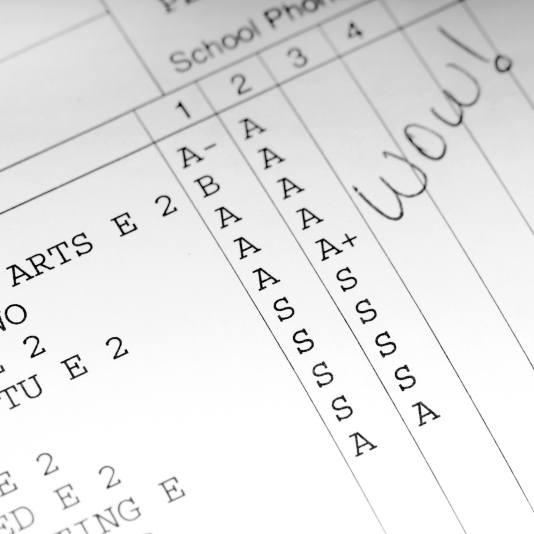
How Do I Calculate My "Real" GPA?
Everyone knows the importance of a high school student’s grade point average, or GPA. It’s the little number that labels us. It signifies whether we are a geek or slacker, or somewhere in between. The GPA is usually either a point of great pride or great shame. Those students who are proud of their GPA practically have it tattooed on their foreheads, while others skulk about in fear that someone might discover what ignoramuses they truly are.
In college admission, it serves as a critical litmus tests: how good a student is this person, and will he or she succeed at this college.
No matter how you cut it, the GPA is a source of anxiety and tension for just about everyone.
But let’s be philosophical for a minute. One’s GPA is not a measure of one’s worth as a human being. It is not even a measure of one’s intelligence. Rather, it is the gauge of a young person’s ability to play the game of school. Some tremendously intelligent students completely blow off school (I have several clients of this variety), while some less intelligent students are able, through sheer doggedness and determination, to achieve relatively high GPAs (there are fewer of these, I find).
Calculating one’s GPA is a fairly straightforward process. Except for the fact that many high schools report “weighted” and “unweighted” grade point averages. In a previous post, I detail the differences between a weighted and unweighted GPA. Basically, a weighted GPA takes into account the difficulty of the courses a student is taking, and those taking harder courses are rewarded with extra “brownie points” in their GPA. Usually colleges strip these brownie points from an applicant’s GPA in order to fairly compare one student against another.
But merely stripping away the brownie points is not enough to uncover your real GPA, because in today’s comprehensive high schools, we give grades for just about every class a student takes, including:
- physical education
- performing groups (including theater and all sorts of music)
- high school sports training
- vocational education classes, like shop, auto mechanics, and the like
- health classes, including sexual education
- student aide or school helper
These courses help pad a high school student’s schedule. But they do not constitute the academic core of high school. Grades in these courses do provide a measure of success (I actually have a client who received an “F” as a student aide–I’m hoping that was a clerical error!). But these grades cannot really be counted as a measure of a student’s academic abilities.
Therefore, to calculate a student’s core GPA, we have to remove the fluff. We have to calculate the GPA based solely on the five academic solids that constitute a high school student’s performance:
- Math
- English or Language Arts
- Social Studies
- Science
- Foreign Language
The core GPA is your “real” GPA: this is the measure of your academic performance in high school. (Again, it’s not a measure of self-worth.) Unless students come to me with a transcript with nothing but grades of A, most students are disappointed to see their 3.0 cumulative, weighed GPA fall to a more embarrassing 2.3 or lower. Those gym classes and band classes are not only fun, but they artificially prop up one’s GPA.
And colleges know it. So those with relatively selective admissions processes will strip the fluff right out of the GPA in order to get down to brass tacks: how well does this particular student perform in academic work?
So, while I hate to be the bearer of bad news, I encourage students from middle school onward to be aware of their “real” GPA as they go through school, and to not be blinded by the number printed on the grade report. They need to be aware that some courses, whether required (health, gym) or not (jazz band, sports conditioning) may artificially inflate their cumulative GPA, and may lead to academic complacency.
The lesson: don’t let yourself be deluded by the numbers on the page. College admissions officers, who must compare one student against another in deciding whom to admit, will strip your GPA of all non-academic fluff. Don’t wait until the fall of your senior year to come to the realization that your GPA may be artificially inflated.
So throw off the rose-colored classes, strip your GPA of all artificial weighting, and strike out all those A grades you received in those electives you love. Ultimately, your “real” GPA is what colleges will consider most carefully.
Now with that out of the way, let’s look at the nuts and bolts of the GPA calculation for students who are awarded letter grades. For each grade in an academic course, assign the following number values to each grade. Then simply divide the sum of these numbers by the number of courses (a simply average). This will be our “Real” GPA.
A = 4.0
A- = 3.7
B+ = 3.3
B = 3.0
B- = 2.7
C+ = 2.3
C = 2.0
C- = 1.7
D+ = 1.3
D = 1.0
F = 0
So, to give an example, let’s say that Stan the Student has a B- in Math, a B+ in English, a C+ in social studies, an A in Spanish, and a B in science, we add the following values: 2.7 + 3.3 + 2.3 + 4.0 + 3.0, for a total of 15.3. Divide by 5 course, and the GPA is 3.06.
Also, you may want to get an idea of how to translate percentages into the numerical grade point average.
Mark Montgomery
College Counselor and
Bearer of Bad News
Technorati Tags: GPA, grade point average, college admission, college entrance, academic Del.icio.us Tags: GPA, grade point average, college admission, college entrance, academic
352 Responses to “How Do I Calculate My "Real" GPA?”
Leave a Comment


So if your GPA significantly improves over te years, it looks better? In 8th grade I took German I and Algebra I and got Bs, giving me a 3.0, then freshman year I averaged a 3.52ish, then sophomore year I had all As, giving me a 3.9, and junior year I had a few more A minuses, giving me like a 3.8, so now my cumulative is a 3.755! So does it look better that I can improve my GPA by over .7 points?
Hello, Delonte. It certainly does look best if you improve! Good job. Remember, however, that colleges generally do not see your 8th grade grades on your transcript…only 9th grade forward.
Best of luck!
really random but could anyone tell me what my unweighted gpa would be if i have a 4.4 weighted gpa?
how do I find out my cummulative GPA? do I add all my GPA’s since ninth grade and divide them by the amount of years i’ve been in highschool?
Hi, Elizabeth. You divide by the number of courses/credits you have. Hope that helps!
Impossible for me to do without seeing all your grades. It depends on which grades are weighted by your school, and by how much. You have to just take the raw numbers and divide by the number of courses or semester or credits, whichever your school uses.
Best of luck.
Hi, Gabe. If you are taking the toughest courses in your school, that will help when it comes to college admission. They will also notice (as long as you point it out) that you made a leap in curriculum. With regard to 12th grade curriculum, the 1st semester really matters a lot. The second semester…quite a bit less. It matters, but by then the decisions already are made.
Hope this helps. Good luck.
In 10th grade I was transferred to another school in another state. The new school will not count my 9th grade grades into my new GPA – this puts me at a disadvantage – what do you suggest I do?
Hi.
Most colleges will recalculate your GPA to include grade 9. When you submit your application and they provide a space for you to “add any other information,” just include a short sentence: “Because I transferred to my present high school from another state between grades 9 and 10, my reported GPA does not include my grades from 9th grade. If it were recalculated to include all my high school grades, my cumulative GPA would be higher.” And then let the college look at it and recalculate. You might also ask your HS counselor to recalculate your total GPA by hand, and include that recalculation in his/her recommendation, known as the “Secondary School Report,” or SSR. That will then make it even easier for the college to view your entire academic record at a glance with greater ease.
Hope that helps.
Hi,
I learned today from our school counselor that In Georgia they use only a four point scale where 90 to 100 is an A and 80 to 89 is a B. Two students – one with all 80′s and one with all 89′s will have exactly the same GPA – namely a 3.0 or B. They do however report the 80 and the 89 on the transcript.
Have you ever heard of this? If so, would colleges look at the 89 or just the 3.0?
Thanks
Hello, Confused.
Thanks for the question. Colleges will see whatever your secondary school puts on the transcript. If they put an 89 on the transcript,then colleges will see it–in addition to whatever averages are calculated by the school. Colleges will “look” at whatever they are given. And believe me, what with 50 states and 14,000 school districts, plus about 3000 private schools and tens of thousands of homeschooled kids–the colleges have seen it all. They have to take into account whatever they are given, and endeavor to make good comparisons among unlike things. It’s a difficult job, but for the most part they do it professionally and dispassionately.
Hope this helps.
Hi Mark,
I know that every college seems to calculates GPA differently. For example, UC’s only take UW 10-11 and disregards pluses and minuses. JHU takes UW 10-12 and uses pluses and minuses. But when we are filling out the Common Application, what GPA do we put down? Unweighted? (9-12, 10-12, 10-11, 9-11: WHICH ONE?) Weighted? (Do I put the weight to all my AP/honors classes?)
Hello:
My son is one step away from high school. He is aim for med school. Reading all the GPA confused me. How do med schools admit students, GPA from high school or GPA from B.S. or combine? Should he compete for a place in excellent private high school or just settle with public school since his GPA will some how probably higher in non competitive public high school then from competitive private high school? Does he need real high GPA to be admitted to Bachelor programs or premedicine?
Thanks
Hello. First of all, medicine is a graduate program. So the graduate program will look only at his undergraduate record, not his HS record. Second, “pre-medicine” is not a major, but a program that can be combined with virtually any major. Many students who major in history, psychology, or philosophy go on to become doctors. In addition, admission to both colleges and graduate schools is also partly determined by test scores. For undergraduates, we have the SAT and the ACT (not to mention the SAT2), and for medical school we have the GMAT. But the answer to your last question is generally yes: those who perform the best get the best chance of moving on. With regard to choosing high schools, it’s hard to speak in generalities. I’d have to know more about your son’s situation to make a recommendation.
Thanks for taking the time to write to us.
Aleena,
You just put the GPA that is listed on your transcript. You are right that different colleges do different things to manipulate your GPA . But on the Common App, you can do one of two things. First, you can just leave it all blank and let the data technicians at the universities in question manipulate the data however they like. They’ll do this anyway, so why bust your own brain cells when their computers can do their dirty work for them. Second, you can just report things the way your school does (use UW, or Weighted…whatever tends to make you look best). This will be fine. Why do the colleges even ask for the information on your Common App? Heaven only knows; but my suspicion is that they are all just lazy. They could get the info from the transcript, or they could just pull the numbers from the Common App. No harm in just leaving the whole section blank.
Hope this helps.
Hi! I’m dominican and here GPA’s aren’t calculated like in the US, here I have a 91.77 GPA, how do I calculate it the US way?
Hi,
I take a rigorous schedule-all honors, but my high school does not weight my GPA. My friends that are all taking classes for easy A’s have higher GPA’s than me, but they aren’t challenging themselves! Will colleges reward me over them for challenging myself?
Howdy.
The answer is generally yes, assuming that you are both applying to the same schools. All things being equal (and they never are, unfortunately), you will have the edge over those who took the easy route. Of course, by assuming that “all things are equal,” that would mean you had earned A grades in all your course, just as they had.
Good luck.
You cannot calculate in the US way. You need to leave your grade average as it is. Your school, then, would need to communicate to the US university how you are graded at your school, and what percentage of students (roughly) earned a 990% or above. Do not try to recalculate your grades. US universities will interpret your GPA as it is.
Good luck.
Hi,
Freshman and Sophomore year, I take mostly honors and accelerated classes (weighted to 4.5 and 5.0 scales) with the exception of orchestra and art classes which an A gets you a 4.0. So far I’ve gotten all As in my classes and so the art and orchestra classes have pulled my GPA down so its about a 4.4 now- but I think without them it would be over a I had the option to waive them from my weighted GPA, but it took filling out forms and I guess I didn’t really think about it then. Do you think that will affect how colleges see me at all vs. someone with the same classes and grades who did waive those classes? And junior year I’m taking all honers classes except for orchestra(but since its the highest this year its on a 4.5 scale)- do you think I should go to the trouble of waiving it, or will it matter?
Becky,
You are worrying too much. You are an excellent student, you have excellent grades, and you are trying to game the system. Don’t worry! Just submit your grades, and the colleges will love you. If you are striving for perfection–and measuring perfection by your GPA–then I’d say go do more music and art and have a good time. You’re focusing on something that won’t really matter in the end. Do what you love. You seem to be doing everything well. So what’s the problem?
Good luck. Everything will be fine.
I am a senior and currently in IB. During my first two years in pre-IB, I had wasn’t in the right set of mind due to some family issues. Throughout the four years, I have taken rigorous classes, I have only had one class that colleges won’t consider as core class which is a performing arts class. Due to intensity of the classes and due to personal life, I had terrible GPA in my first two years but there is a positive change that can be seen in my transcript going from 2.2 to 3+. My cumulative weighted is 3.79 out of 5 and is definitely increasing. If I were to properly state my problems and explain the rigor of my classes in my essay, would that possibly cause the colleges to disregard or at least take into consideration everything that was going on and downplay my freshman and sophomore years? Is there anything that I can do help push myself further away from my GPA and show that I am intelligent and would do well in college and just had a difficult time in high school?
Thanks
Hello, and thank you for your answers. I can’t bring myself to making my child’s HS experience overbearing to just play the “AP” game. Given she is an excellent student with a 96.4/100 class average (4.0 unweighted) at the end of her first year, named freshman of the year in her band section, made all state in her freshman year for her sport , is it ill advised to wait until the junior and senior years and take only 2 AP classes per semester? Is it not more important to do well on the SAT I and II and have maybe 4 AP courses (or less) in which she scores a 3 or higher and a high unweighted GPA? Her school offers up to 20 AP’s. But I’m sorry. HS biology is not UG biology is not Grad School biology even if the same person was teaching the course. The depth and breath of knowledge the student (and instructor) brings to the course determines what will be extracted. Thank you for your thoughts.
How do collages calculate the GPA from 9th grade to 12th grade?
Hello,
I am a bit confused…when the colleges ask for my GPA to the nearest decimal should I give them my most current GPA or my Cumulative GPA?
My school has different grading scale an A would be 93-100. Will colleges take that into account if I get an A on my grades.
Hi Mark I was wondering how IVY league schools calculate their GPA’s, do they evaluate grades 9-12 with equal weight or is greater emphasis placed on grades 10-11 like the UC system? I’m curious about this because I had straight A’s freshmen year and good grades my first semester of my senior year
My son is a Freshmen ; he has AP/ college prep classes. His grades are high B s and C ‘s. Im a very concerned parent – how does the GPA work for 9th grade . He however is excelling in band!!! Can we change his classes to college prep only at this stage. Planning to speak to the counsellor after the quarter report.
Hi, Terri. Thanks for writing in. It’s possible your son is over his head if he’s already in AP courses and not flourishing. Ninth grade “counts,” but perhaps a bit less than 11th grade. The big question is what is causing him to get those Cs. Is he unprepared? Is he not developmentally ready? Or are they just too hard? Talking to his counselor is a good idea.
Best of luck.
Colleges will get a “secondary school report” that explains how grades are awarded at your school. So they will take your context into account.
Cumulative.
Add up all the grades and divide by the number of credits. Most US high schools put the GPA on the transcript. If you are not a US student, leave that part of the application blank and submit your academic record however it is written. The universities will interpret it from within your own national curricular context.
Are “real” electives that do not fall into math, science, English, foreign language, or history included in core GPA? One example is Accounting.
my school uses a scale where a 4.0 is all A+’s so will my gpa be adjusted to the 4.0=A scale when i apply to colleges
Bob,
You need to ask your school how your GPA will be reported to colleges. I have no real way of knowing the precise answer to your question…but officials at your school will be able to respond with clarity. Good luck.
Accounting is likely considered a business elective, but usually is not considered a “core” academic course. Some university programs (especially those in accounting) will look more closely at the grade in accounting than others. But “core” GPA does not, generally speaking, include electives like accounting. That said, it’s great to take the course and do well in it, if that is something you wish to pursue.
Good luck, Chris!
Hello,
I was worried about my GPA. My GPA is 2.7. Is that goood enough to find a scholarship. Please reply and you can please tell me an effective way of learning and an effective way to get a 4.0.
Thank you!
Hi, Tommy. A 2.7 GPA is probably not the best for getting a scholarship. It might be possible, depending on what other assets you bring to a college. But you’re instincts are right: you need to figure out how to double down and bring up the grades. I recommend anything and everything Cal Newport writes (his website is called “Study Hacks”). I could give you some personal advice, too, if you and I were to have a conversation or two about what you’re doing now and how you could improve your study skills and habits. If you’re interested, give us a ring here at 720.279.7577 and we’ll see if we can’t find a way to be helpful to you.
Best of luck.
Hi Mark, I attend a school that uses a 5 pt scale for the GPA, and it’s weighted as well for the AP courses. I currently have a 5.05 GPA, but most scholarships are asking for the real GPA. How do I determine my true GPA? Is there a formula? Please advise.
Laurant,
You, yourself, do not need to translate on your applications. You simply put what your school reports. If you are applying to an outside, third-party scholarship, then include the “school report” that your US high school sends with your transcript. Go to the guidance office and ask for this document–every school should have one. Colleges will get this automatically and will do their own formula to determine your eligibility for the scholarship. Judging by the fact that your GPA is above 5.0 on a 5-point scale, you’re doing well. Don’t worry about formulas–just make sure that the school or scholarship organization has enough information to judge your abilities.http://greatcollegeadvice.com/wp-admin/edit-comments.php#comments-form
Good luck!
Hi,
Which grade is more important in calculating our “real” GPA average?
In my school the GPAs are really low and are the administration offices consider the GPAs according to our schools? Are AP exams beneficial for the applications?
Thanks
Hi, Jade. The colleges will take all the grades you earned and make their own determinations. AP courses are definitely beneficial, if they are available to you. Your secondary school will send your grades, along with an explanation of their grading policies. So you will be evaluated within the context in which you have been educated. I hope that’s helpful.
Daniel,
Ivies want to see solid grades all the way through. But if your grades are not perfect, they do like to see improvement from year to year…in part because high school does get harder from year to year. So all things being equal, the trend should be upward from 9th to 12 grades. Hope that helps.
Hello,
It is difficult to balance out AP courses. The important thing is that your student does not take on more than she can manage. If 2 AP classes per year is the right load for her, then that is what she should take.
Katherine Price
Senior Associate
Montgomery Educational Consulting
Hi Jeff,
It is perfectly fine to write a separate essay on your college applications that describes the difficult time you had your first two years. You should focus on what you have done to improve. Colleges do like to see an upward trend in grades, so it is good that you are on the right track!
Good luck!
Katherine Price
Senior Associate
Montgomery Educational Consulting
My school bases its grades on an eight point scale. A 93 to a 100 is an A. I am currently taking two AP courses this semester. I’m getting a high B in one of them but I’m affraid it’s going to hurt my GPA. If I get a high B in the course, does that mean that it counts only as a 4.0? Or can it be something like a 4.3? I’m a bit confused.
Thanks for answering my question. My next one is does information technology classes like programming count towards real gpa.
Hello. The answer depends, in part, on how your school classifies the course. Is it considered “math” credit, or is it primarily an “elective” credit. If elective, it may not factor into your “real” GPA.
Hope that’s helpful!
Hi Kat,
You GPA is going to depend on your school’s grading scale. So if your school does not have a traditional grading scale (A is 90 to 100, etc) then you would need to adjust your GPA according. When colleges review your transcript, they will make note that you school does not have a traditional grading scale.
Hope that helps!
Katherine Price
Educational Consultant
hello i m completed my B.E. Computer science from india with 60.55% so can u tell me how much GPA is there now days i m in usa and i have green card and i m doing job in good company.and i want to do masters in usa but there is some confusion can any body guide me