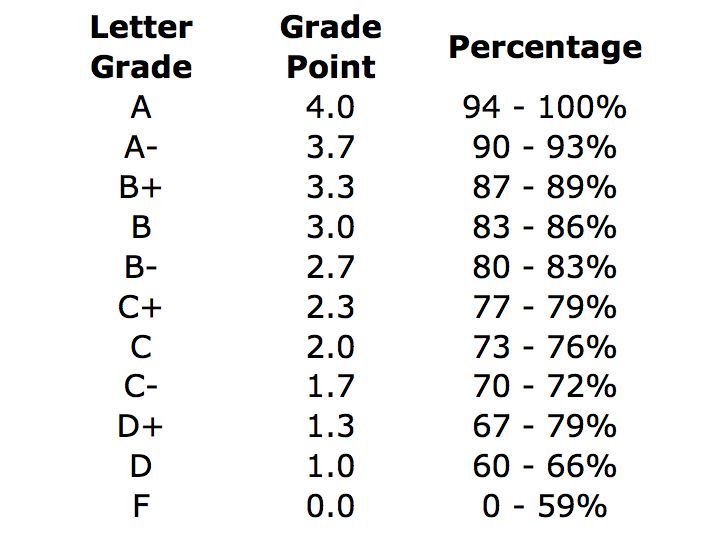
How to Calculate Your GPA–Letter Grades and Percentages

One of my most popular posts is about how to calculate your “real” GPA.  Some readers have asked how to translate grades expressed as a percent into letter grades, and then into a GPA based on a 4.0 scale.


Below is a chart that can serve as a starting point.  Recognize,  however, that all schools and colleges will have their own grading policies.  This is one way to translate one kind of grade into another.  It’s meant as a helpful tool, but you should always investigate how individual colleges and schools handle this translation before making any assumptions about how they will consider your own performance.


If you’re worried about your GPA, it’s likely that you are a bit nervous about how your GPA will affect your admission to college. There are three things to keep in mind.

First, it’s not just about your GPA overall.  You need to pay close attention to your core GPA.

Second, you need to think first about which colleges fit you best.  It may turn out that you are worrying too much for the wrong reasons.

Third, if you are having trouble fitting all these pieces together–your GPA, your test scores, your interests, your aptitudes–you may want to consider asking for some professional advice from an expert who can help you navigate the college admissions process.

Interested in a free consultation?  Send me a note!

Mark Montgomery
Educational Consultant


Technorati Tags: Del.icio.us Tags:

About the Author

Mark Montgomery

As a former professor, administrator, and high school teacher, Mark has the knowledge and skills to counsel students as they make the transition from high school to college.

221 Responses to “How to Calculate Your GPA–Letter Grades and Percentages”

  1. Manish Bastakoti says:

    Mr Montgomery,
    My school implies a B+– 90-93% and an A to be 93+. While colleges look for the GPA scores are they made aware of this fact or is this not thought essential cuz now i realize that its unfair for us compared to other schools.
    Manish

  2. Mark says:

    Hello, Manish. Thanks for the comment. But do not despair. While your grading scale is different, it will be reported to colleges when your transcript is submitted to the admissions offices. I can’t say that the admissions process is always completely fair (frankly, it is not and never will be), I can say that admissions officers do try to be fair, and they are aware that it is difficult to compare apples to oranges when looking at transcripts from different schools. They get pretty good at interpretation. So just keep working hard, and aim for that 95%!

  3. Emmanuel says:

    The ranges are 50-55=C6, 56-60=C5, 61-65=C4, 66-70=B3, 71-75=B2, 76+=A1. Thats the way it is calculated in Nigeria. But i need the GPA. Thanks

  4. Mark says:

    Emmanuel,
    Thanks for visiting and for pointing out that transcripts in other countries do not look at all like those in the US. For students from other countries seeking entry into the US, colleges will either do the “translating” themselves (if they have the expertise on campus to do so) or they will turn to third party transcript and reference services to verify the authenticity of the transcript and to translate (both in terms of language of instruction and the grades earned).
    Most colleges and universities have dedicated admissions officers to international recruiting, so interested and able students need not worry that their grades will not be given full consideration.
    Hope you find this helpful, and good luck on your educational quest.

  5. alhaji says:

    hi! plese sir, i want to know when, how grade point average (GPA) start exist in Nigerian high institution.

    the history of the Grade point average(GPA) and CGPA.

    THANK YOU.
    IWILL BE VERY GREATFUL IFMY REQUEST IS DUE CONSIDER AND REPOND IN TIME.
    ALHAJI B. U.NIGERIA, BORNO STATE, JERE.

  6. Mark says:

    Dear Alhaji,
    Thank you for your question. I am not an expert on Nigerian secondary schools, so I cannot give you any definitive answer. I can tell you, however, that US colleges will give your transcript due consideration. Please keep in mind, however, that very few US institutions offer any financial aid for foreign nationals. So in most cases, you will be expected to pay for the entire cost of your college education–and document this ability to pay–before the US government will provide you with a visa.
    Hope this is somewhat helpful.

  7. Chris says:

    Hi, I’m a student from Canada applying to a school in California, and was told I am considered “out of state” for fees, and was just checking for my GPA but was very surprised (in a bad way) at how it is translated. In Ontario, you are considered on the honour roll (which means you are some of the highest grades) and I’m pretty sure 80% must be atleast a B, because if you have a total average of 80% in your classes (i think just U level ones though, so higher ones), you are considered on the honour roll. Does this mean that since the school I’m applying to considers me “out of state” I will have more trouble getting in when in a Canadian university I wouldnt because I am considered very smart? I would really appreciate a reply, thank you.

  8. Mark says:

    Hi.
    No matter what your school marks may be, your residency (and, in this case, citizenship) determines your status for both admission and financial aid to state-supported universities in the US. The most sought-after public universities have two different enrollment models (or acceptance rates) for applicants from in-state and for applicants from out of state. At places like Berkeley, UCLA, Michigan, U-Texas, etc…it is much tougher to get in if your parents do not pay tax in that state. As a Canadian, you will be considered an “out of state” student for admission and tuition purposes.

    Hope this helps a bit! Thanks for reading my blog!

  9. Framyk says:

    Hello,
    I’m from Central Africa and we have a grading system similar to the one in France. The scores are given over 20 (10/20, 12/20, 16/20…) and a score of 16/20 is considered very good, 14/20 and 15/20 are considered Good. So if the GPA is as I just saw here, I’m going to have problem for B-school admission.
    What should I do??

  10. Mark says:

    Hello, and welcome to my blog. Thanks for visiting and for your question. First off, where in Central Africa are you? I’m quite curious as to which country you come from (obviously one of the Francophone ones!).

    Second, my blog tends to address American readers. For international students (who make up a growing percentage of my client base), considerations of GPA are quite different. Having taught for a year in France, I know that a 14 and 15 are quite good, and a 17/20 is astronomically high. Rest assured that when international students are considered for admission to US universities, their national grading systems are taken into account. For universities with a large foreign student population, usually there is expertise within that university to help translate transcripts and other documentation. Alternatively (and I often recommend this for my clients) an applicant can have his or her transcript validated, translated, and interpreted by a third party provider–thus ensuring that your transcript will be given due consideration, despite the fact that it looks different from an American one.

    I hope this helps. If you need more specific guidance, don’t hesitate to drop me an email using the contact form.

  11. Ram says:

    I have an aggregate percentage of 73 for an undergraduate course of 4 years what would be my gpa score???

  12. Ram says:

    Sorry!! Forgot to add that I am from India

  13. Mark says:

    Hello, Ram.

    In general, transcripts from secondary schools outside the US must be evaluated by educators with particular expertise in both American universities and the educational systems of a variety of countries around the world. Generally, when I begin working with student from outside the US, I try to understand the educational system–and the grading system of each school of the students I work with.

    Occasionally, I require that students have their transcripts submitted to a third party evaluator to give me a better sense of the student’s performance.

    I’m afraid that in this case, I do not have the time to dig deeply into the ways in which your secondary school evaluates your course grades. I would want to know what the highest score in the class is, as well as the lowest. I would also want to understand your class rank.

    I think you need to be less concerned about the exact translation of your secondary school score into an American GPA, and more concerned about how well you are doing at your secondary school. If a 73 is a score that puts you way above the rest of your peers, then (of course) a 73 is excellent. In an American context, your 73 might put you at a C or even a C-. But the translation means nothing without context. And any good admissions officer will be sure that your secondary school score is evaluated in the context in which it was earned.

    Hope that helps!

  14. Justin says:

    Hello Mark,
    I find your site very useful and i must say that’s a good job.At the moment,I’m studying in Russia and my GPA is 4.4 but i will be going to Ghana after completion and i would be very grateful if you could help me translate my GPA to the level in Ghana and whether it’s a first class or not.Thank You.

  15. Mark says:

    Justin, thanks for your comment. I’m afraid I don’t know much about the educational systems in either Russia or Ghana, so I can’t help you with that. I suggest that you contact the university in Ghana directly and ask your question about how they evaluate transcripts for admission and placement. Good luck!

  16. Framyk says:

    Sorry for the delay. I’m from Cameroon, yes it’s a francophone country in Centra Africa but English is one of the official languages and 20% of Cameroonians are native english speakers. I’m from the francophone part of the country.
    Do you provide MBA admission consulting services? I’d like to go for an MBA and I think I need some help.
    Regards.

  17. Katherine says:

    Hello!

    I am from the States and am applying for my second Bachelor’s at a Canadian university. When they consider my admission, do they convert my GPA over to their system and then make a determination or do they just base it off of where I came from?

    Also, is there a direct site or somewhere to find out what my GPA would transfer to up there? I had a 2.38 which is a C down here. I think it would be higher up there, so hopefully this would be an advantage for me.

    Thanks for any help you can offer.

  18. Mark says:

    Hi, Katherine,

    Thanks for your message. First off, I’m just curious as to why you are doing a second Bachelors degree. Interesting path to take.

    As for your transfer GPA, the admissions folks will be quite able to interpret your 2.38 as a C, and then translate that to their admissions requirements. Different Canadian universities have different requirements, and some will take a C for admission. Most Canadian institutions are very experienced in eyeballing the GPA from the US. I don’t think you need to worry too much about “translating” something that doesn’t really need translation.

    Is the 2.38 in your current Bachelors program? Or is that your secondary school grade?

    Thanks for writing.

  19. Andrew says:

    The school I go to (in NJ) multiplies grades in honors courses by 1.05 and grades in AP courses by 1.1. The only grade that goes on your report card are the “weighted” grades (with the multiplier). My school puts number grades on the report cards.

    To calculate my unweighted GPA, do I have to get rid of the multipler weight? For example, I got a 95 in English on my report card. Since this is an honors course, my raw score was a 90 (90 x 1.05 = 94.5 = 95). Do I use the 90 or the 95 for my unweighted GPA?

    Thank you.

  20. Mark says:

    Hi, Andrew. The answer is that you should use the “raw” score as your “unweighted” GPA. The multiplier gives you “extra GPA credit” for taking honors and AP courses, which is all helpful in calculating your class rank–but your “unweighted” GPA is your raw score of 90, not the 95 you get by using the multiplier.
    Hope this helps!

  21. John Steed says:

    Hi Mark,

    I am a US student completing an MSc in mathematics and statistics by distance learning with the University of Cape Town. As of today, I have an average of 62% on a South African grading scale. Would you have any way of knowing what this could correspond on a US GPA scale?

    Thank you

  22. lisi says:

    so what gets me, is that my high school counts:
    90+ as a 4.0
    80-89 as a 3.0
    75-79 as a 2.0
    and a 70-74 as a 1.0
    then these are all just averaged
    so what if i get all 92′s, and my transcript says i have a 4.0?
    will colleges translate that into a 3.7?

  23. Mark says:

    Hi, John. I’m afraid I don’t know, and I don’t have any clients in South Africa (yet) so I’ve not had the occasion to learn. I suggest you connect with the office of Education USA in South Africa. The folks there can probably help you find the right answer. Good luck, and thanks for stopping by my blog.

  24. marcos says:

    Mark
    I’m a bit confussed. I am from Chile, where the grade range goes from 1 to 7 (4 is Paas/fail).I have to have a GPA of 2.5 for the school I’m applying but I don’t know how to calculate it. I have a 5.2 (from 1-7 scale)

  25. Mark says:

    Hola Marcos,
    Gracias por tu pregunta. I am not completely up to date on how best to translate every transcript into the American equivalent. My suggestion is to call the admissins office of the college to which you plan to apply and talk to the coordinator of international admission and ask that very question. In most cases, the admissions representatives will be more than happy to talk to you and to give you the answers you need. If they aren’t, please come back to this post and let us all know who they are!

    Thanks for visiting my blog!

  26. marcos says:

    Thanks Mark. I’ll let you know
    cheers

  27. Ljiljana says:

    I am from Macedonia and our college grades are 5-10, can you tell me how that translates to A,B,C.. or to gpa 3,4.
    If not can you tell me if there is an agency that translates diplomas and grade transcripts from other countries.
    Thank you

  28. Mark says:

    Hello, Ljiljana,
    Thanks for the question. I am not an expert on the Macedonian educational system. But if you’re looking for a translation of your diploma, you might want to check out http://www.universitylanguage.com/. Keep in mind, however, that many of the larger universities in the US that seek students from abroad will do the translations (and pay for them) themselves. No matter where you come from, foreign student transcripts and grades will be judged within their own context, and not directly “translated” into a US-style “grade point average.”
    Hope this helps!

  29. jamie says:

    well.
    in prince willam county..
    we dont have such letter grades like “a-”,”B-”"C-”…

    so my question iss that if i get an A(93)in my school then do they calculate 93 as a 3.7 instead of 4.0?

  30. Mark says:

    Hello, Jamie.
    Thanks for the question . The answer is that colleges will see whatever Prince William County Schools put on your transcript. If they see only the A, then they will base calculations on that. If they see the 93%, then they will base calculations on that.

    Remember, none of this is as scientific as we’d like it to be, and remember that schools across the country have different policies in what they report to colleges.

    Just know that college admissions folks are professionals and will be familiar with how to compare your transcript with others. In the end, your transcript is being compared not with that of others in other schools. Your transcript is being rated in the context in which you go to school.

    So again, it’s the job of admissions folks to crunch numbers, and then to interpret them in light of the school you attended. And rest assured: few will be unfamiliar with Prince William County.

    Best of luck!

  31. harsh says:

    hi i am from india i am doing BE chemical from one of the best institutes here and have 65% till my second year and have got 91% in my 10th standard and 84% in 12th i want to pursue masters in petroleum at texas wat other than the gre is required to get there i mean about how much % and ya i more thing i have numerous extra curricular activities from hosting international confernces to sports to student politics posts plz give a reply as early as possible

  32. Mark says:

    Hello, and thanks for your question.

    I think you should be able to pursue a graduate degree in the US. I’d have to take a closer look at your academic record to be able to know which universities will consider you a competitive candidate. Your scores on the GRE would be important, as well as the rest of you background. My associates and I have experience in looking over transcripts from India, so if you’d like some professional advice, I’m sure we could help you out. Also keep in mind that there are some good petroleum engineering programs outside of Texas that you might want to consider.

    Thanks again for writing, and let me know if we can be of assistance.

  33. CY black says:

    Hello , i was want to know if having a good GPA would help me get scholarships to pay for college?

  34. Ria says:

    Hi,

    I feel the information you have provided is not accurate. I’m saying this because I have got a 72% in Master’s and that is rounding off to a c- which implies that i am a very weak student. But that is not so as I have ranked 6th in graduation in Kolkata and 1st in masters. So, as far as I know I’m not a dumb student.

    Thank you

  35. Mark says:

    Dear Ria,

    Thanks for your comment. Please keep in mind that the grading system I am explaining is the American one. Other countries use different grading scales. For example, France uses a scale from 1 to 20. In Mexico, it is 1 to 10. The percentages required to earn a passing grade are different around the world, too.

    What counts, therefore, is your context: admissions officers in the US (as well as educational consultants like me) have experience in translating grades and transcripts from other countries into a form that allows us to evaluate them fairly.

    Thanks again, and let me know if I can be of further assistance.

  36. Mark says:

    Hi, CY. The answer is yes.

  37. Lary says:

    Hey Mark

    My name is Lary. I am a student in Israel. I have a 80% in my Bachelor’s GPA. I could probably reach a 82% by the end of the exams.
    How much is it in an USA GPA ? Is it a 3.0 GPA ( and/or more) ?
    Thank you very much for your helpl

  38. Krista says:

    THANK YOU. That’s all I really had to say. I had my GPA in percentage, and was spazzing out because I couldn’t figure out the exact 4.0 Scale I had. I knew it was around a 3.0, but I wasn’t positive the right one. So thank you, so very much. :) . You do good for my college-spazzing mind.

  39. Mark says:

    Krista,
    Thanks for the nice note. Glad I could help–at least a bit–during the spazzing process. Try not to let it get to you, and if I can be of further assistance, I hope you’ll give me a holler.

  40. Mark says:

    Hello, Lary,
    I am not an expert on Israeli transcripts, but I could do more digging for you to help you find the answer, if you’d like my assistance. However, most large US universities have expertise on their staffs to help them interpret transcripts from other countries. In addition, many universities will require transcripts from other countries to be translated and certified by third party organizations or companies.

    But here is a general rule to keep in mind: all transcripts are judged by the context in which they were earned. Therefore, your grades will be examined in the context of your secondary school and the educational system in which you live. If an 82% is considered to be the top of your class, then you will be considered to be at the top of your class. If, however, significant numbers of your peers are earning 90%, 93%, or even 98%, then your performance will be evaluated within that context.

    I hope this is helpful. If you are seeking admission to a US university and would like some personal assistance, don’t hesitate to send me a note on the “Contact” page of this website.

    Good luck, and keep up the good work!

  41. veer says:

    hey, i dont think that conversion table is correct because in most of the universities in india the average distinction percentage is 70% its considered pretty good and 60 % first division and at your table its showing 59% is failure….snt it funny to compare like tht?

    GPA is based on your score relative to the top ranker score….so similarly percentage also must be converted in that way then only its justifiable…like if your percentage is 70% while top ranker in your class is 85% then an approximate GPA would be like 4*70/80= 3.5 gpa could be considered as decent in both ways….
    correct me if iam wrong.!
    thank you.

  42. Katherine says:

    Hello,

    You are correct that the grading in India is very different than it is in the United States. Evaluating grades from India also depends on the school and what exam results are being presented. For example, an admission officer evaluating results from the India Certificate of Secondary Education would probably consider 60 to 100% as the equivalent to an A, 45 to 59% as the equivalent to a B and so forth. For the Central Board of Secondary Education, 75 to 100% might be considered an A and 60 to 74% a B and so forth. It can be complicated, but admission officers do spend time researching the grading procedures and scales used when evaluating a transcript. It can also be helpful for international students to have their transcripts officially translated and converted by a third party. I hope this answers your question!

    Sincerely,

    Katherine Price
    Senior Associate

  43. Funsho says:

    I have a weighted average of 2.68 because of the three arts courses I took that dropped by grades, but an unweighted average of 3.3. I was just wondering, how does this look like to a top tier college, such as Brown University?
    Sorry for giving such a strange question
    Thank you

  44. Mark says:

    Hello, Funsho.

    Your question is a bit strange, on the surface, but not completely out of the ordinary. Your unweighted GPA will look better to all colleges than your weighted average, but I imagine your grades in those art courses are pretty low if they dragged down your GPA more than half a point. Top tier universities do not like low grades–wherever they appear. Sometimes they overlook them if the student has amazing talents in other areas or is otherwise highly desirable. But there’s not way to get around the fact that your transcript has some blemishes.

    My advice would be to consider Brown, but to also look at a variety of other colleges that are similar to Brown but that might be more willing to overlook those blemishes. In order to make recommendations, I’d need to know a lot more about you, including your test scores, the kinds of courses you have taken in high school, and the extracurricular involvements you are pursuing. If you’d like me to help you draw up a list, let me know!

  45. klavin says:

    hi completed the University of Ghana with a second class lower.The majority of graduate schools in America require a B or 3.00 G.P.A and according to the WES website free service my second class lower is equivalent to a B. Should i start applying?

  46. Ahouse says:

    I have a question about GPA. How would I figure GPA at home? Please explain this as simply as possible. Thank you.

  47. Ahouse says:

    I am from the USA if that helps with my previous question.

  48. Mark says:

    Hello, and thanks for your question. I’m unsure what you are asking. Are you asking about devising grades and GPA for a homeschooler, or are you asking about how to calculate the GPA at home? Thanks again for stopping by!

  49. Ahouse says:

    I am asking how to calculate GPA for my son. He is homeschooled.

  50. Ahouse says:

    The grading scale I use is as follows.
    92-100 A
    81-91 B
    75-80 C
    70-74 D
    below 70 F

Leave a Comment