Skip to content
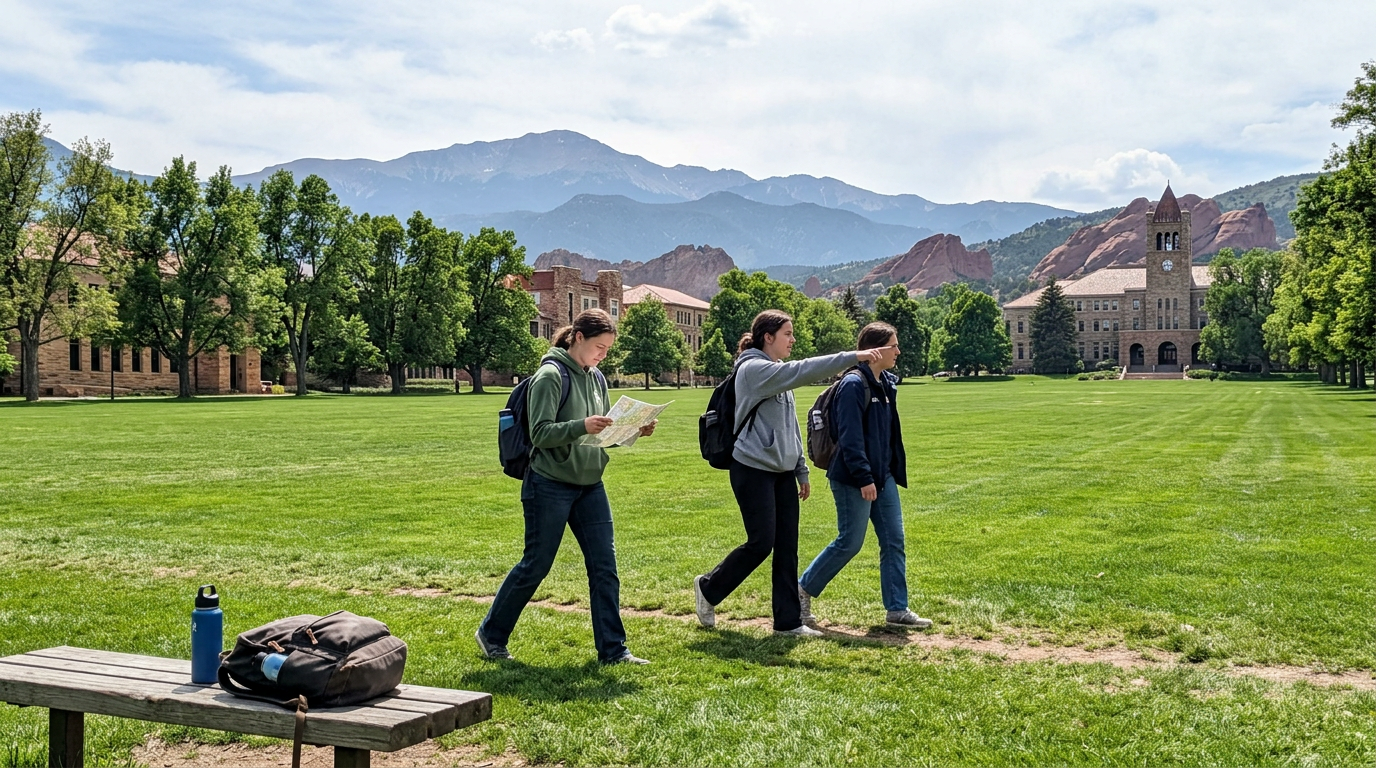
Colorado College sits on one of the most photographed campuses in the country, framed by Pikes Peak and the rock formations known as the Bluffs. It also sits at the top of nearly every “most selective college in Colorado” list. For families building a college list, that selectivity is usually the headline. It shouldn’t be. Selectivity tells you almost nothing about whether a student will thrive there, and at Colorado College specifically the more consequential decision has nothing to do with acceptance rates: it’s whether a student’s learning style is built for the Block Plan. This piece walks through what actually makes Colorado College different, why its selectivity is the least useful data point in the decision, and what families should evaluate instead before this school goes anywhere near an application list.
The Block Plan at a Glance
Question | Colorado College’s answer |
|---|---|
How you take classes | One class at a time, in 3.5-week “blocks” of 18 class days, eight blocks a year |
Daily schedule | Class usually 9 a.m. to noon, with afternoons for reading, labs, and field study |
Between blocks | A block break of about four and a half days before the next class starts |
Best suited for | Students who focus best on one subject at a time, including many with attention challenges |
Harder fit | Students who need longer runways to absorb dense material or dislike sprint-and-recover pacing |
The real question | Not the acceptance rate, but whether single-subject immersion matches how you learn |
Why Is Selectivity the Wrong Place to Start?
Selectivity gets treated as a scoreboard. It shouldn’t be, because an acceptance rate describes the applicant pool, not the classroom experience a student will live in for four years. Colorado College is the most selective school in Colorado, located in Colorado Springs with views of Pikes Peak. That selectivity is real, and it matters for admissions strategy. But it tells a family nothing about the single most important variable at this specific school: the academic calendar.
The mistake we see most often is a student adding Colorado College to a list because a counselor, a ranking, or a family friend flagged it as “the hard one to get into,” without ever asking whether the way Colorado College teaches matches how that student learns. That is a backwards process. Selectivity should be the last filter applied to a list, not the first, because a school a student can’t succeed in academically is not a good outcome no matter how difficult it was to get in.
What Is Colorado College’s Block Plan?
Colorado College is one of a small number of colleges nationally that runs on the block system, and this is the fact that should drive the decision. Instead of taking four or five classes across a 16-week semester, students take one class at a time. Each class runs three and a half weeks, about 18 class days, meeting daily, usually from 9 a.m. to noon, with afternoons reserved for reading, labs, and field study. There are eight blocks across the year, four per semester, so the credits add up the same as a traditional schedule, just with far more intensity and depth.
This is a fundamentally different cognitive demand than the four or five-classes-at-once model most high school students are used to. Some students are built for it and others are not, and the distinction is not about intelligence or work ethic. It is about how a student’s attention and processing style handle single-subject immersion versus juggling multiple parallel commitments.
Who Does the Block Plan Actually Work For?
The Block Plan is not a neutral scheduling quirk. It serves one cognitive profile well and can work against another, and families should run this diagnostic before anything else.
Students with attention challenges often respond well to the format because they are not studying four subjects at once and can stay genuinely focused. That is a real, mechanism-based advantage: single-tasking removes the context-switching cost that makes traditional semesters difficult for some learners. The format also appeals to students who simply feel they would do their best work in a single-focus structure.
But the same structure that helps a focused learner can overwhelm a student who needs time to let material settle. Compressing a semester of biology, for example, into a few weeks is genuinely demanding, though Colorado College has run this model for more than 50 years and has a proven system for supporting students through it. Graduates leave ready for graduate school and careers. The output is proven; the path to it is not comfortable for every learning style, so a student who needs longer runways to absorb dense material, or who struggles with high-intensity short bursts, should stress-test this honestly before applying.
Colorado College is an intentional choice, and its admissions officers want to make sure applicants have given this a lot of thought. The college’s supplemental essay wants students to show why CC is a good fit for them:
One of the benefits of Colorado College’s Block Plan is the opportunity to immerse yourself fully in a single subject for 3.5 weeks. We see this as the luxury of focus—the joy and value of directing your full attention to one thing. Tell us about a time when you experienced this kind of deep focus in an academic or extracurricular setting. What were you doing, and how did it turn out?
Factor | Traditional semester system | Colorado College Block Plan |
|---|---|---|
Course load structure | 4 to 5 classes at once over 16 weeks | One class at a time over 3.5 weeks (18 class days) |
Daily schedule | Classes spread across the day and week | Class usually 9 a.m. to noon, afternoons for reading and labs |
Best suited for | Students who manage multiple parallel workloads well | Students who focus best on one subject at a time, including many with attention challenges |
Break structure | Traditional semester breaks | About 4.5 days off between each block |
Main risk | Juggling competing deadlines across subjects | Compressing a full course into a short, intensive window |
What Is the Lifestyle Trade-Off Families Overlook?
The Block Plan’s calendar also shapes daily life in a way that is easy to romanticize and important to evaluate honestly. After each block, students get a block break of about four and a half days: they finish with a final and are then free to hike, ski, do laundry, or rest before the next class begins. That rhythm, roughly 18 days of intense work followed by a short release, repeats all year, and the college also folds in study abroad and summer blocks.
For an adventurous student who wants to take full advantage of the Colorado outdoors, that rhythm is a genuine draw. But families should be clear-eyed that this is not a conventional weekend-and-summer calendar. It is an intensive-then-release cycle, and a student who thrives on steady, predictable pacing rather than sprint-and-recover should weigh that carefully. Because students often head to the mountains during breaks, it is also worth checking whether a campus empties out at those times. Our guide on how to tell whether a college is a “suitcase school” covers how to read a campus’s weekend culture before you commit.
How Big Is Colorado College, and Who Is It For?
Once the Block Plan question is settled, scale matters more than selectivity. Colorado College is a small campus of just over 2,000 students, where students get to know their classmates well within a first block and then meet a new group in the next. That size, combined with the block rotation, produces a tight-knit but constantly refreshing social structure: a student’s closest academic community can shift every few weeks, which is a very different experience than a traditional four-year cohort model.
This matters because Colorado College serves a specific kind of academic seeker. A student who wants a rigorous liberal arts and science education, is well-rounded, and is not yet sure what to study is exactly who this school is built for. That undecided-but-serious profile, a student who wants breadth and rigor without committing early to a narrow professional track, predicts fit far better than any admission statistic. It also helps to understand how a liberal arts model differs from a big research university, which our comparison of a research university versus a liberal arts college lays out.
How Should You Evaluate Fit Before Applying?
Treat the decision as a diagnostic process, not a prestige calculation. Here is the sequence we walk students through.
Test the single-subject immersion model honestly. Ask the student directly: do you do your best work when you can set everything else aside and focus on one thing for a stretch, or do you actually perform better rotating between different kinds of thinking across a day? There is no universally right answer, but there is a right answer for that specific student.
Visit during a block, not just for a general tour. A standard admissions tour won’t show what week three of an 18-day organic chemistry block feels like. Sit in on a class and ask current students what a hard week looks like, not just a good one. Our guide on sitting in on a college class explains how to arrange it and what to watch for.
Map the academic goal against the format. A student targeting pre-med, engineering, or another sequence-heavy STEM track should ask specifically how prerequisite chains and lab-heavy courses work inside a compressed block, since short timelines change how cumulative material is absorbed and retained.
Weigh the social rhythm. A student who wants a stable, unchanging friend group across four years may find the block-to-block reshuffling either energizing or exhausting, and that reaction is worth surfacing before enrollment, not after. Our overview of the academic elements of a good college fit can structure that self-assessment.
Only then, treat selectivity as an admissions-strategy question. Once fit is established, selectivity becomes a legitimate planning input: it tells a family how much of the list should be reach versus target versus safety, and how hard the supplemental essays need to work to show genuine understanding of the Block Plan specifically, not Colorado College generically.
What Mistakes Do Families Make With Colorado College?
Adding it because it’s “the selective one in Colorado.” Selectivity should be the last filter, not the first. The Block Plan is the actual differentiator and should be evaluated before the acceptance rate ever enters the conversation.
Assuming the Block Plan is just an intensive normal semester. Taking one class at a time for 3.5 weeks, in class each morning and studying that same subject each afternoon, is a structurally different learning model, not simply a faster one, and it needs to be judged on its own terms.
Writing a generic “why us” essay that never mentions the Block Plan. Because Colorado College is one of only a few block-plan schools, admissions readers look for evidence that an applicant understands and wants this format. A student who can’t articulate why single-subject immersion suits them has not done the homework the application requires.
Ignoring how the format interacts with the intended major. Highly selective schools expect students to have taken calculus when their high school offers it, and that rigor expectation applies at a school like Colorado College inside a compressed timeline, which raises the stakes on entering with strong foundational preparation in the intended field.
The Takeaway
Colorado College’s selectivity is a real constraint on application strategy, but it is not the reason to apply or the reason to walk away. The decision that actually matters is whether a student’s learning style is built for one class at a time over three and a half intensive weeks, followed by a short release, repeated all year. Get that answer right, and Colorado College’s small, tight-knit, liberal-arts-focused community becomes one of the strongest fits in the state. Get it wrong, and the school’s selectivity becomes an obstacle a family fought hard to overcome for a poor outcome.
If your student is weighing Colorado College against other Colorado or national liberal arts options and isn’t sure whether the Block Plan fits their learning style, that is exactly the fit analysis our counselors work through with families before a single application goes in. We would rather help you rule a school out for the right reasons in October than watch a student struggle with the wrong academic model in April of freshman year. Schedule a consultation with our team to talk through whether Colorado College, or another block-based or liberal arts program, actually matches how your student learns best.
Frequently Asked Questions
What is Colorado College’s Block Plan? It is an academic calendar in which students take one class at a time for three and a half weeks, about 18 class days, rather than juggling four or five courses across a semester. Classes usually meet from 9 a.m. to noon, and there are eight blocks a year with a short block break between each one.
Is the Block Plan good for students with ADHD or attention challenges? It can be a strong fit. Focusing on a single subject removes the context-switching between multiple courses that many students with attention challenges find difficult. It is not automatic, though: the pace is intense, so a student who needs longer to absorb dense material should test the format honestly before applying rather than assuming it will help.
How long is a block, and what happens between blocks? Each block runs three and a half weeks. After a student finishes with a final, there is a block break of about four and a half days before the next class begins. That intensive-then-release rhythm repeats through eight blocks a year.
How big is Colorado College? It is small, with just over 2,000 students. Combined with the block rotation, that size creates a close-knit community whose academic groupings shift every few weeks, a different social experience than a traditional four-year cohort.
Is Colorado College worth applying to just because it is the most selective school in Colorado? No. Selectivity should be the last thing you weigh, not the first. The more important question is whether single-subject immersion matches how your student learns. If it does, the school’s community and academics can be an excellent fit; if it doesn’t, a hard-won acceptance can still lead to a difficult four years.