Skip to content
Colorado School of Mines is a public STEM university in Golden, Colorado, where every student is working toward a degree in science, technology, engineering, or math. There are no majors outside those fields, so the culture is built around one shared commitment: students who want to build things, solve hard problems, and put in the work. Understanding that culture, not just the admissions stats, is what actually helps a family decide whether Mines is the right fit.
We work with families across the country who are drawn to Mines for its reputation. But reputation only tells part of the story. What matters more is what daily life feels like on a campus this size, in this location, with this level of academic intensity. Here is a clear look at the student experience: the traditions, the rigor, and the career outcomes that make the workload worth it.
Colorado School of Mines at a glance
Dimension | What defines Mines |
|---|---|
Academic focus | STEM only; no majors outside science, technology, engineering, or math |
Signature strength | Engineering, with mechanical, computer science, and chemical among the most popular majors, plus equally rigorous physics, chemistry, math, and applied science |
Size | About 6,200 undergraduates roughly 2/3 male and 1/3 female; roughly 8,000 students total |
Defining tradition | The M-Climb during freshman week, ending at the white “M” above Golden |
Location | Golden, Colorado, at the base of the foothills |
Athletics | NCAA Division II; football national runner-up in 2022 and 2023 |
Career outcome | Among the top public universities in the country for return on investment; No. 1 in Colorado |
Cost and aid | Merit scholarships for in-state and out-of-state students; about 88% of students receive grant or scholarship aid |
What makes the culture at Mines different from a typical STEM program?
At most colleges, students weigh campus vibe, class format, and the mix of majors around them. At Mines, that calculation narrows from the start, because the academic environment is uniform. Every student is on a rigorous STEM track, and the culture is built to support that rather than to accommodate a wide range of interests.
There is no undecided-major crowd wandering into an elective to figure out what they like. Everyone in a lecture hall, lab, or study group has already committed to a technical path, and that shared focus creates a campus identity that is tighter and more specific than a general liberal arts school offers.
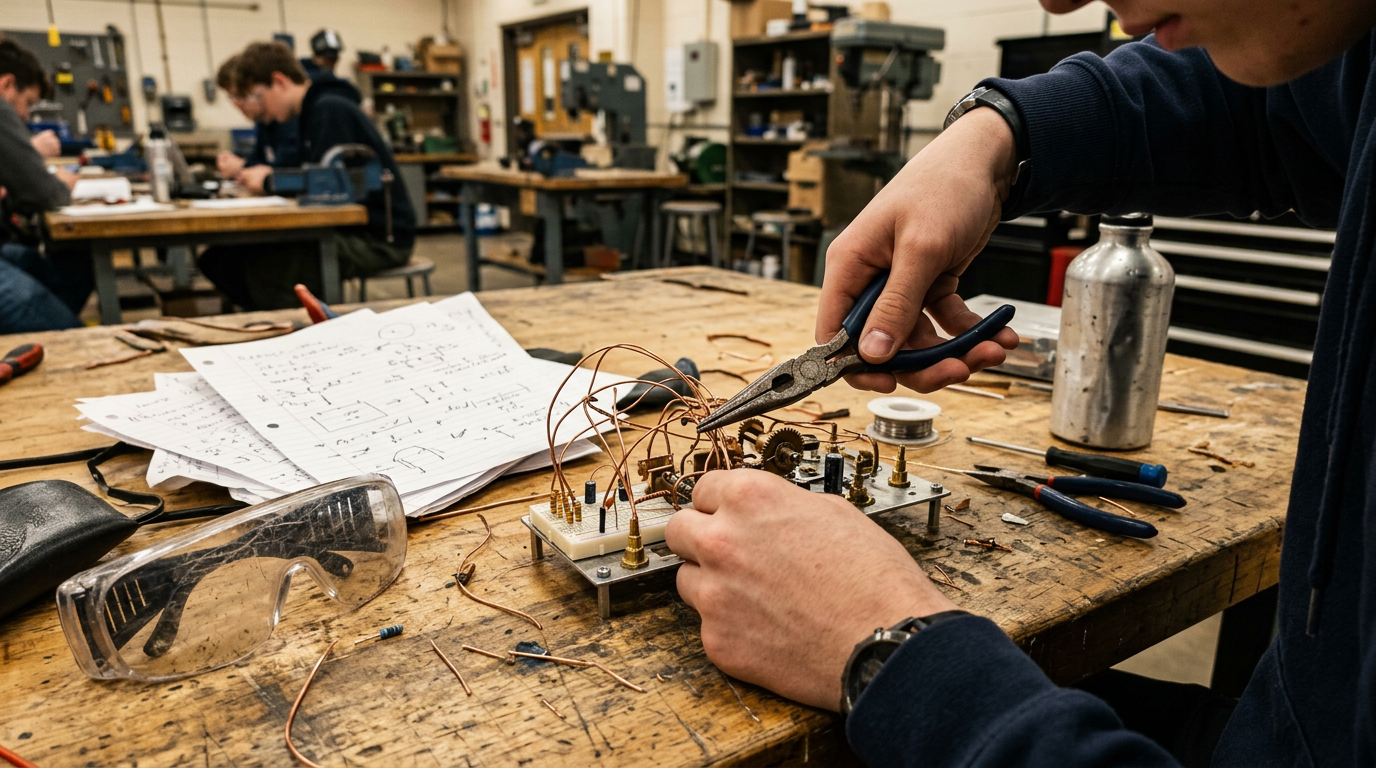
Mines is best known for engineering, and it shows in the facilities: hands-on teaching labs the length of a football field, built on the idea that engineers learn by doing. But the hard sciences are just as strong. Chemistry, physics, math, and computer science are all demanding, and Mines is a serious option for students on a pre-med track.
Who thrives at Mines?
Students who prioritize their studies. This is not a place where academics are one priority among many. The students who describe Mines as a great fit are the ones for whom problem sets and lab work are the organizing feature of their week, not an obligation squeezed between other things.
That does not make the culture joyless. Downtown Golden is a small, walkable stretch of coffee shops, restaurants, and boutiques, and on a Tuesday night you will find study groups working together over coffee. At Mines, the social scene and the academic scene are not separate spheres. Studying together in public, in a town small enough that students run into each other constantly, is part of how the community works.
What traditions define the Mines identity?
Every college has traditions. The ones at Mines are worth understanding because they reveal what the school values: collaboration, grit, and a shared identity that starts in week one.
The M-Climb
During freshman week, new students each carry a rock from their hometown and climb the hill next to campus to place it on the giant “M” on Mount Zion. Upperclassmen then whitewash the new rocks. The result is visible for miles. Drive through Golden or head up toward the mountains and you will see the big white M on the hillside. Locals and visitors alike recognize it instantly as the mark of Mines.
The ritual matters more than the hike. New students bring something personal from home and place it into a shared symbol that upperclassmen formally welcome into the collective. It sets the tone for a campus where each incoming class is absorbed into a tight, identifiable community rather than left to find its own footing.
Athletics, Greek life, and the outdoors
Mines is demanding, but it is not humorless. The football team competes in NCAA Division II and reached the national championship game in back-to-back seasons in the 2020s. Students show up, and it is fun to follow.
The social side goes beyond athletics. Mines has fraternities and sororities, parties, and active outdoor clubs that head out to ski and hike. Students get their work done, get outside, and go on to land strong jobs. Serious recreation and a real social scene sit on top of serious academic output, not in place of it.
Size makes that balance work. With about 6,200 undergraduates and roughly 8,000 students total, classes stay small enough to know your professors, while the campus is big enough that you keep meeting new people and always find your people.
Why does location matter so much at Mines?
Mines sits at the base of the foothills in Golden, Colorado, where the land starts going straight up right next to campus. That geography is not a backdrop. It is part of daily life. Colorado draws students who want an outdoor lifestyle, and Golden puts the mountains within reach rather than hours away.
The same students who spend Tuesday night buried in a problem set often spend Saturday on a nearby trail or driving up to ski. The rigor of the coursework does not cancel out the setting. For a workload this heavy by design, the mountains work as a release valve.
Is a Colorado School of Mines degree worth it?
By the numbers, yes. Mines is consistently ranked among the best public universities in the country for return on investment, and it is No. 1 in Colorado. That payoff comes from the strength of its engineering programs and its deep institutional roots in energy, earth, and resource fields, alongside high-demand areas like computer science.
Starting salaries are among the highest of any public university. Median pay in the first few years after graduation runs around $79,000, and the highest-paying engineering majors, such as petroleum engineering, start closer to $90,000 and up. Mid-career earnings climb well past $130,000.
The value is not only in the paycheck. Mines awards merit scholarships to both in-state and out-of-state students, and roughly 88% of students receive some grant or scholarship aid, which brings the real cost well below the sticker price. If return on investment is high on your family’s list, Mines belongs on it.
What does a typical week look like at Mines?
A week at Mines has a rhythm that is distinct from a big public university or a liberal arts college. Weekday evenings often mean small study groups, frequently off campus in Golden’s compact downtown rather than an anonymous library carrel. Coursework is front-loaded with foundational STEM sequences, engineering labs, and hard-science requirements that do not let up.
Weekends pull the other way, toward the outdoor lifestyle that drew many students to Colorado in the first place: skiing, hiking, and mountain access that a town like Golden makes easy. Greek life, outdoor clubs, and a proud Division II football program round out a social calendar that is real, even if it is not why most students chose Mines. Tying it all together is a campus small enough that professors know students by name, and large enough that four years does not mean the same 200 classmates the entire time.
How do you know if Mines is the right fit?
The strongest predictor of success at any college is whether a student will actually be happy there. As one of our counselors puts it, students should ask themselves, “Where am I going to be happy and where can I have some fun?” When students feel comfortable on a campus, they tend to do well. A strong name and strong outcomes data do not automatically make a school the right environment.
For a student who loves problem-solving, does not mind a heavy workload, and wants mountain-town access to the outdoors, Mines offers a rare combination: small-school intimacy, elite technical training, and a shared identity built on traditions like the M-Climb that make a rigorous experience feel communal rather than isolating. For a student who wants to explore several academic directions before committing, the single-track STEM focus that defines Mines will feel limiting rather than energizing. That trade-off is exactly what a good college fit is about: matching a student to the academic and social experience that fits them, not just the one with the best-known name.
Fit has a weekend dimension too. Before committing, it is worth checking whether a campus stays alive on weekends or empties out as a suitcase school. It is one of the details a brochure will not tell you.
If you are trying to work out whether the intensity and identity of a specialized STEM campus like Mines matches your student’s learning style and goals, our Colorado team can walk through that fit assessment with you, drawing on the same firsthand campus knowledge behind this piece. When you are ready, schedule a free consultation.
Frequently asked questions
Is Colorado School of Mines only for engineers? No, but every program is STEM. Engineering is the signature strength, and Mines is also strong in computer science, applied math, physics, chemistry, and pre-med preparation. It does not offer majors outside science, technology, engineering, and math.
How many students attend Colorado School of Mines? About 6,200 undergraduates, and roughly 8,000 students including graduate programs. That is small enough for small classes and knowing your professors, but large enough to keep meeting new people.
Is a Mines degree worth the cost? Mines is consistently ranked among the top public universities in the country for return on investment and is No. 1 in Colorado. Starting salaries are among the highest for any public university, and merit aid is available to both in-state and out-of-state students.
What is the M-Climb? A freshman-week tradition where new students carry a rock from their hometown up Mount Zion to the giant “M” above Golden. Upperclassmen then whitewash the new rocks, welcoming each class into the community.
Where is Colorado School of Mines located? In Golden, Colorado, at the base of the Rocky Mountain foothills, with quick access to skiing, hiking, and trails.