Skip to content

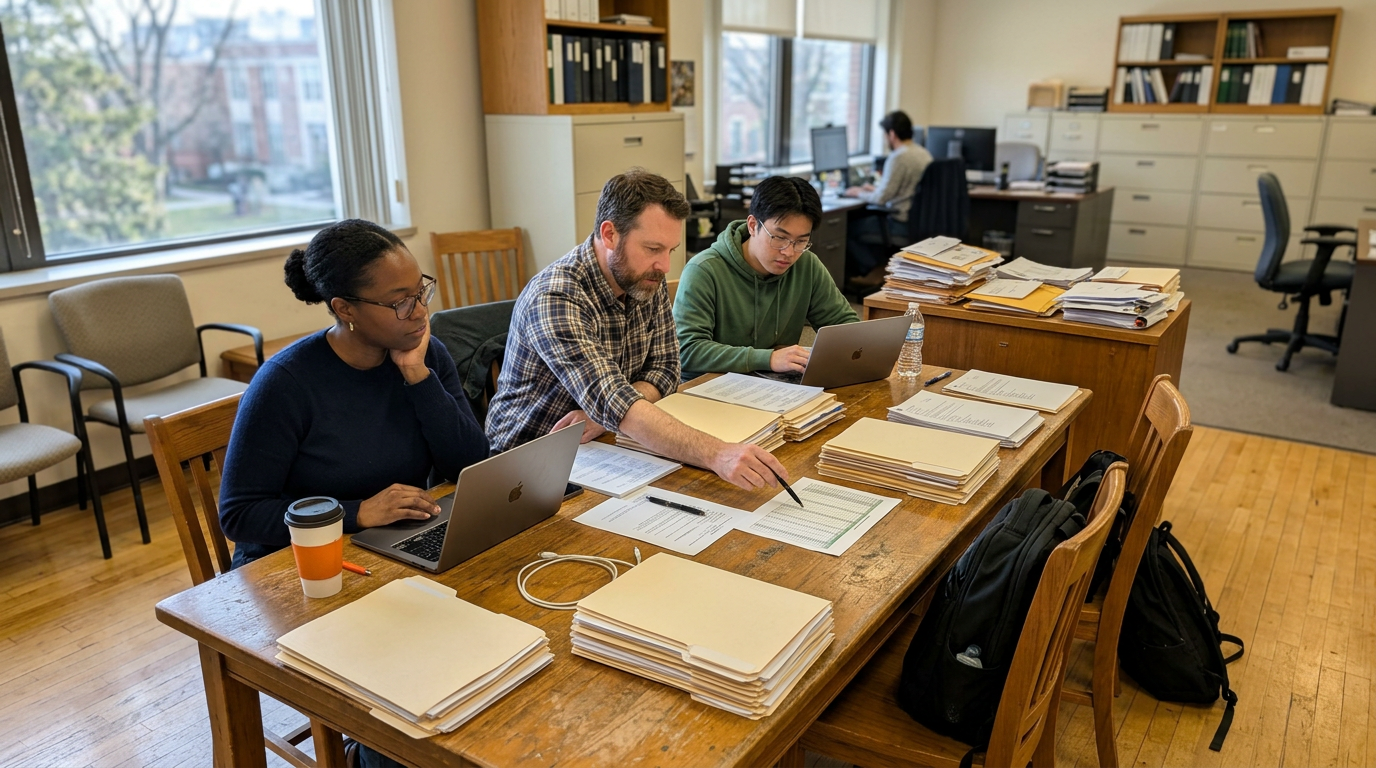
Families researching schools are not the only ones experimenting with artificial intelligence this admissions cycle. Admissions offices themselves are testing where AI fits into reading files, screening essays, and managing the sheer volume of applications flowing through increasingly under-resourced offices. The result is a patchwork of policies, pilot programs, and informal practices that vary enormously from one institution to the next, and understanding that patchwork matters more than ever for applicants trying to figure out what colleges actually see when they open a file.
The confusion is understandable. Headlines oscillate between “AI is reading your essays” and “AI detectors don’t work,” and both statements contain some truth depending on the office, the tool, and the specific task being automated. At Great College Advice, we work directly with admissions data, essay review processes, and the families navigating this shift, and the clearest signal we can offer is this: AI’s role inside admissions offices today is narrower, more cautious, and more varied than most public conversation suggests. This article breaks down what we actually know about how colleges are using AI, where human judgment remains dominant, and what that means for how students should approach their applications.
Why This Matters: The Gap Between Perception and Practice
The biggest misunderstanding families bring to this topic is the assumption that admissions offices have either fully automated essay review or are running every essay submitted through a reliable AI detector. Neither is accurate. Specific university policies illustrate how narrowly scoped most official AI guidance actually is. NC State, for example, maintains an explicit AI policy for admissions essays that permits brainstorming and structuring assistance but prohibits the direct submission of AI-generated language, requiring applicants to sign terms stating their materials were not created by AI. Cornell has published similar guidance for prospective students on what generative AI use is and is not acceptable in an application.
These policies tell us two things. First, institutions are aware students are using AI tools and are writing policy specifically to address it rather than ignoring the issue. Second, the policies are aimed at the input side (what students submit) rather than announcing that the institution itself is using AI to evaluate those submissions. That distinction gets lost in most discussions about “AI in admissions,” and it is the single most important thing applicants need to understand.
The stakes of getting this wrong cut in two directions. Students who assume admissions offices can’t tell the difference between authentic and AI-generated writing may submit essays that read as generic, overly polished, or disconnected from the rest of their application, a mismatch that experienced readers notice. Students who assume every essay is being scanned by an AI detector may over-sanitize their language or avoid using AI as a legitimate brainstorming tool, losing a genuinely useful resource in the process.
How Admissions Readers Actually Evaluate AI Use
Context Matching, Not Detection Software
The most consistent theme across admissions professionals and counselors is that offices are not primarily relying on AI detection software to catch AI-written essays. Instead, readers use a far more reliable method: comparing the sophistication of the writing against the rest of the application. As one college counselor with direct insight into admissions reading described it, evaluation “is all about the content and voice. they aren’t, mostly, checking if it’s written by AI. Those days are gone. They know students use AI.” The red flag isn’t AI use itself; it’s a mismatch between the essay and the student’s demonstrated academic profile.
This context-matching approach was echoed by a self-identified application reader for a top 10 school, who noted that “most readers and admission staff know right away if AI was used” without needing a detection tool. Admissions readers who review thousands of applications a year have a trained sense of how a given GPA, course rigor, and test profile typically correlates with writing sophistication. When an essay’s voice and insight wildly outpace a student’s transcript, that gap, not a percentage score from a detector, is what raises questions.
This is consistent with why AI detection tools themselves are now widely considered unreliable for this purpose. Admissions professionals note that AI detectors are not reliable enough to determine whether an essay was written by AI, which is why false positives are so common, and that offices are “far more interested in whether the essay sounds authentic and is consistent with the student’s overall application than in the output of any single detection tool.”
What AI Genuinely Cannot Replicate
Admissions offices have converged on a specific limitation of AI that shapes how they read essays: AI can produce competent prose, but it cannot generate the lived reflection that selective admissions committees are actually screening for. As one counselor put it, AI “can’t write about your feelings, concerns, outlook, philosophy on life, etc. That’s reflection part that AI could write nicely, but can’t create unless you expressed it clearly.”
This observation matters for understanding admissions office behavior because it explains why so few institutions have invested heavily in AI detection infrastructure. If the differentiator readers are trained to look for is depth of reflection rather than surface-level fluency, a detection score is almost beside the point. A perfectly “human-sounding” essay that lacks genuine insight will still read as weak, and a well-supported, reflective essay that happens to trigger a false positive on a detection tool is not the problem admissions offices are trying to solve.
The Holistic Review Process Still Resists Full Automation
A recurring debate among counselors and admissions-adjacent professionals centers on whether AI could eventually replace holistic review entirely. The consensus from people closest to the process is that it cannot, at least not for selective institutions managing large applicant pools with limited spots. As one commenter put it bluntly, “AI definitely can’t do a quality holistic app review. It’s not all stats. It’s grades and rigor within context, extra curriculars, personal statement and LORs.”
At the same time, there is acknowledgment that AI’s analytical capabilities extend further than pure number-crunching. One counselor noted that AI “has the ability to analyze essays for theme, quality of writing, etc.”, even while stopping short of endorsing that as the right use case for actual admissions decisions. This is the honest middle ground: AI can process and flag patterns in text, but the judgment calls that define holistic review, weighing rigor against context, letters against activities, and a personal statement against a transcript, remain a human function at institutions that genuinely practice holistic admissions.
The following table summarizes where AI currently fits (and doesn’t) in the admissions office workflow based on documented institutional policy and reader-reported practice.
Admissions Function | Current AI Role | Human Role |
|---|---|---|
Essay authenticity screening | Minimal reliance on detection software | Readers compare essay voice against transcript, GPA, and test scores |
Policy enforcement | AI usage disclosure required at some schools (NC State, Cornell) | Admissions staff interpret disclosures case by case |
Holistic file review | Not used for final decisions at selective schools | Counselors and committees weigh rigor, activities, essays, and letters together |
Essay content/theme analysis | Technically possible per reader commentary | Human judgment determines what “authentic voice” means for a given applicant |
Supplemental essay volume management | Cited as a factor in schools reducing essay requirements | Staffing and reading capacity remain human-limited |
Why Some Schools Are Reducing Supplemental Essays, Not Automating Them
One of the more revealing admissions trends of the past cycle has been institutions scaling back supplemental essay requirements, a move some observers initially assumed was a step toward AI-driven review. The reality discussed among counselors points the opposite direction. Reducing essays does not appear to free up resources for automation; it reflects the practical reality that large applicant pools make comprehensive human reading harder to sustain.
Importantly, counselors pushed back hard on the idea that fewer essays means a shift to stats-only, AI-scored admissions. One response argued directly that a school with Georgia Tech’s selectivity profile “will not be stats, at a school like GT there is no way to do this on stats alone, too many academically talented applicants and too few spaces. Academics will make you competitive but it will be activities, honors, LOR and personal statement” that ultimately differentiate applicants. The practical takeaway for students is that fewer essay prompts raise the stakes on the essays that remain, along with activities, honors, and letters of recommendation, rather than signaling that an algorithm is about to take over the first read.
Practical Application: What This Means for Your Application Strategy
Given what we know about how admissions offices actually operate, students and families can take several concrete steps to align their application strategy with reality rather than myth.
Use AI as a Feedback Tool, Not a Drafting Tool
The distinction between using AI to generate ideas versus using it to generate final language is the single most important line admissions offices have drawn, both formally in published policies and informally in reader expectations. A productive use of AI looks like uploading a completed draft and asking for feedback on whether “the main point is coming across, where it is getting lost”, or requesting suggestions to “strengthen the structure” without AI-generated rewording. This keeps the authorship and voice with the student while using AI the way a careful editor would.
What should be avoided is using AI to generate the narrative content itself. One experienced writing mentor observed that even when parents attempted to use AI to guide a child’s essay drafts, “at best, they were just better ‘sounding’ essays. Content wise, they oftentimes even made the essay worse”, stripping out the “janky” but authentic details that make an essay distinctive. If you are struggling with the ethics or efficacy of these tools, you might ask, “Should I Use ChatGPT to write my college essay?” The answer from admissions officers is increasingly a firm “no” for the final draft.
Understand That Disclosure Requirements Are Becoming More Common
Students applying to schools with explicit AI policies, such as NC State’s requirement that applicants acknowledge their application materials were not created by another person or by a generative artificial intelligence system, need to treat that attestation seriously. These policies exist precisely because institutions recognize the brainstorming-versus-authorship line is one students need explicit guidance to navigate. Check each target school’s admissions website for AI-specific language before finalizing essay drafts, since policies vary and not all institutions have published guidance yet.
Don’t Panic Over AI Detector Scores
Families who run essays through multiple AI detection tools and see inconsistent results are chasing a flawed metric. One parent reported running an essay through four different checkers and getting results ranging from 0% to 75% on an essay they knew their daughter had written entirely herself, ultimately deciding to stop checking altogether. Admissions professionals confirm this instinct is correct: the detector score is not what determines how an essay is read. If a student genuinely wrote their own essay, reflecting their own voice and experiences, the detector output is close to irrelevant to how an admissions reader will evaluate it.
Preserve Your Drafts and Editing History
Several admissions-adjacent professionals pointed to documentation as the practical safeguard against any authenticity concerns, AI-related or otherwise. Keeping draft versions and a visible editing trail provides a defensible record of the writing process. This advice aligns with a broader shift some educators are making at the college level, where professors are moving toward approaches like requiring students to write in supervised settings or defend their written work in an oral conversation specifically because a finished essay alone cannot prove authorship.
Common Mistakes Applicants Make Around AI and Admissions
Mistake: Assuming an essay with a low AI-detection score is automatically “safe” and an essay with a higher score is automatically suspect.
Correction: Admissions readers are evaluating voice and context consistency, not detector percentages. A student’s own writing can register a false positive due to common phrasing, while an AI-smoothed essay can register a low score if lightly touched. Focus energy on authenticity and depth of reflection, not the number a browser extension produces.
Mistake: Using AI to write a complete first draft and then editing for tone.
Correction: Once AI generates the initial narrative, the distinctive, specific details that make an essay memorable are often lost in the process of “polishing,” producing writing described as “sanitized” and stripped of rich detail. Generate your own raw material first; use AI only to refine structure and clarity afterward.
Mistake: Believing that because some schools are cutting supplemental essays, personal statements matter less.
Correction: Counselors directly rebutted this assumption, noting schools still want the personal statement and that it becomes more load-bearing, not less, when other essay opportunities disappear. This is particularly true as competition intensifies at popular institutions; for instance, many families are noticing that applications to Southern colleges are up 50%, making the personal statement a critical differentiator in a crowded field.
What This Means Going Forward
Admissions offices are not building AI-powered application-reading pipelines at the scale public conversation sometimes suggests. What they are doing is writing clearer policies about acceptable AI use during the drafting process, training readers to spot inconsistencies between an essay’s sophistication and a student’s broader academic record, and, in some cases, adjusting the structure of their applications (like reducing supplemental essay counts) for reasons tied to application volume rather than automation. The through-line across every documented institutional policy and every admissions-adjacent professional’s account is the same: authenticity and context, not detection software, remain the operative standard.
For families, the practical path forward is straightforward. Use AI as a sounding board for structure and clarity, never as a ghostwriter. Document your drafting process. Check the specific AI disclosure policy at each school on your list, since requirements like those at NC State and Cornell are becoming more common rather than less. And recognize that the qualities admissions readers are actually screening for, reflection, specificity, and a voice consistent with the rest of your file, are precisely the qualities AI cannot manufacture on a student’s behalf.
If you want a clear-eyed read on how a specific essay, activity list, or application strategy will land with the admissions offices on your list, our counselors at Great College Advice, a college admissions consulting company, can help. Schedule a conversation with our team to see how we help students craft winning essays that resonate with admissions officers – in their own voice.