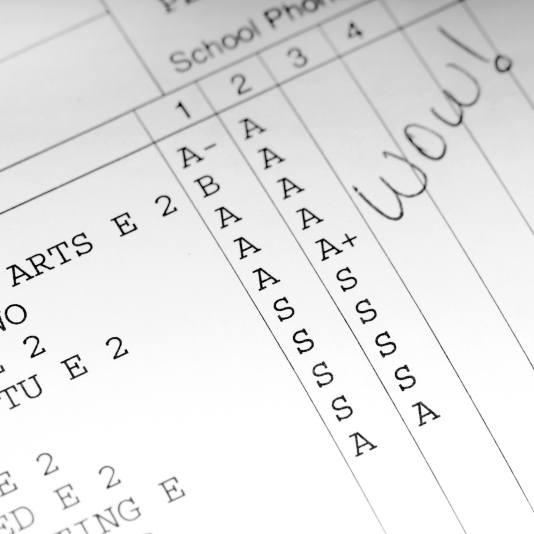
Your transcript is the single document that tells colleges the most complete story about who you are as a student. Before you obsess over an essay or a test date, it helps to understand what admissions officers see when they open it, because they do not read it the way most families assume. They are not scanning for a GPA number and moving on. They read the transcript as a story with a beginning, a middle, and a trajectory. This guide walks through a self-diagnostic review you can run on your own transcript right now, component by component, so you see what an admissions officer sees before they do.
Transcript Review at a Glance
Transcript component | What to check |
|---|---|
Graduation requirements | All required credits, including health, PE, fine arts, and government, are on pace to finish by senior year |
Course history | Each core subject’s sequence escalates across four years rather than plateauing |
Grades by semester | Core-class grades separated from electives, since colleges recalculate on core courses |
Trend line | Semester GPA plotted across all terms: rising, flat, declining, or spiky |
Weighting key | How your school weights honors, AP, and IB courses |
Summary statistics | Your GPA measured against your school’s average or distribution, not in isolation |
Why Should You Periodically Review Your High School Transcript?
Admissions offices do not take your GPA at face value. Many colleges plug your transcript into their own institutional formula and produce a recalculated GPA unrelated to the number on your report card. The reason is simple: GPA is not consistent from one school to the next. The typical US scale runs out of 4.0, but many schools add weight for honors and AP courses, so a weighted average can climb to 5.0 or even 6.0. Some schools report numeric grades out of 100, and IB coursework runs on a seven-point scale. Put all of that together and it is clear why colleges do not simply trust the number on the page.
If you do not audit your own transcript the way a college will, you are flying blind. You will not know whether your GPA reads as a strength or a liability until someone else recalculates it. Running this audit yourself, ideally starting freshman or sophomore year, puts you in control of the narrative instead of leaving it to chance.
What Is the Difference Between Weighted and Unweighted GPA?
The first step in any transcript audit is understanding the difference between your unweighted and weighted GPA, because colleges look at both and they tell different stories.
A weighted GPA solves a specific problem: two students can both earn an A, but the intellectual demand behind those A’s is not equal. It is often easier to earn an A in a ceramics class than in AP Physics C, one of the most difficult courses in high school, so those two A’s do not reflect the same capability. Weighting corrects for this by assigning extra value to harder courses. An A in ceramics might translate to a 4.0, while an A in AP Physics C might translate to a 5.0 or 6.0, which is why a weighted average can exceed 4.0. It works a little like Olympic scoring, where athletes are rated not just on execution but on the difficulty of the routine.
To run your own recalculation, separate your grades into two columns: core academic classes and everything else. Colleges recognize five core areas, math, English, social studies, science, and a foreign language, and they weight those the most. Electives like band, PE, and ceramics still get reviewed but carry less weight. Colleges often pull out the core grades and recalculate your GPA in those courses alone rather than relying on the blended number on your application. So the real audit question is not “what is my GPA?” It is “what is my GPA in core classes?” If elective grades are propping up your overall number while core grades lag, that gap will surface the moment a college recalculates, so find it first. Our breakdown of weighted GPA, unweighted GPA, and class rank explains how colleges strip the weighting back out.
How Do Colleges Read Your Grade Trajectory?
A GPA collapses years of performance into one number. Colleges deliberately unpack it to see the trend behind it, and your high school transcript review should do the same.
Two students can post the exact same cumulative GPA and tell completely different stories. A student who had a rocky freshman year while adjusting to high school, then gained study skills and steadily improved, shows an upward trend that colleges like to see. Compare that to a student with the same cumulative GPA whose grades started strong and then declined, a pattern that suggests the student may be less prepared for the rigor of university work. If your own transcript includes an early dip, our guide on whether bad grades keep you out of college covers how to frame a recovery.
To track your GPA trend, plot your semester GPA, not cumulative, across all four years and label the shape: rising, flat, declining, or spiky. A flat, high line reads as consistency. A rising line reads as growth. A spiky or declining line invites questions, and you want to be the one answering them.
Course sequencing is a second, quieter signal. A student who moves from Algebra I through Geometry, Algebra II, Precalculus, and AP Calculus AB demonstrates deliberate escalation in rigor. A student who plateaus at Algebra II tells a different story, even with identical A’s. Trace each core subject as its own line through all four years and ask whether it shows forward motion or a stall. This is easy to overlook because it requires reading across years, but an admissions officer notices it within seconds.
One common misunderstanding is that students must choose between hard classes and good grades. The guidance is both: take the hardest classes you can succeed in, do well in them, and stay functional outside of school. Whether AP or dual enrollment looks better usually depends on the rigor of your own high school’s curriculum. Flag any semester where rigor rose and grades dropped sharply, and plan to address it through application context or a course-load conversation.
What Counts as a Good GPA?
A GPA number means nothing in isolation. There is no single figure that defines a good GPA. A transcript has to be read through three frames: your personal context, your high school’s context, and the target college’s context. Our counselors apply all three to every transcript, and so should your self-review. For the fuller version of this reasoning, see our piece on what a good GPA actually is.
Context | What it measures | How to audit it yourself |
|---|---|---|
Personal | Growth relative to your own starting point | Compare freshman year GPA to junior year GPA and look for improvement over a rocky start |
High school | Where you rank relative to classmates at your school | Ask for your school’s average weighted GPA or distribution and see where you fall |
College | Where admitted students’ GPAs and percentiles land | Check the college’s published percentile breakdowns for the entering class |
Personal context is your own trajectory. A student who struggled freshman year with a GPA around 3.1, then climbed to a 3.8 by the end of junior year, should be proud of that growth.
High school context is where most families go wrong. A 3.9 weighted GPA might sit at the top of the class at one school, but at a school where the average is 4.2 because of heavy AP and honors enrollment, that same 3.9 could land in the bottom half. Ask your counselor for the school’s average or distribution. A lack of class rank is not a disadvantage in itself, since many high schools do not rank and colleges interpret performance from the transcript without it.
College context is about placement, not the raw number. Colleges care less about your GPA on its own than about where it puts you within your class. Admitted-class data is often most useful broken down by percentile: what share of admitted students ranked in the top 10%, 25%, or 50%. Cross-reference your own percentile against a target school’s published breakdown for a far more realistic read than a raw GPA comparison, as our explainer on cumulative GPA and percentiles lays out.
Which Graduation Requirements Should You Check First?
A high school transcript self-review is not only about optimizing for selectivity. It starts with confirming the basics. Every school requires specific numbers of credits in specific areas, sometimes including health, physical education, fine arts, or government. Guidance counselors generally track these, but students and parents still need to stay vigilant so no one reaches senior year missing a vital requirement. Run this check first, before any GPA optimization, because a missing credit is a structural problem no course strategy can fix retroactively.
Should You Worry About an Individual Grade in a Class?
One mistake we see repeatedly is treating every quiz grade as a crisis. What actually matters are the semester grades, not each individual quiz or homework assignment, so resist the temptation to refresh the grade portal too often. Think at the semester level instead. A student who struggles on tests can put extra effort into papers or major projects to buffer the overall grade. And when a genuine grading question comes up on a specific test or paper, be a good self-advocate and raise it directly rather than letting it sit.
How Do You Turn Your Transcript Self-Review Into a Strategy?
A transcript audit is not a one-time exercise for the week before college applications are due. It is a diagnostic tool worth revisiting every semester, starting as early as freshman year, so any weak signal gets caught while there is still time to address it.
Consider a student with a 3.7 unweighted GPA. Your transcript review should include the following:
Graduation requirements: Confirm all required core and elective credits are on pace for senior year.
Core versus elective: Pull out grades in math, English, social studies, science, and world language only. If strong PE and elective grades are masking a lower core GPA, address that gap before the transcript goes out.
Trend mapping: Plot semester GPA freshman through senior year. A flat 3.7 reads differently than a 3.4 climbing to a 4.0, even at similar cumulative averages.
Course sequencing: Confirm math and science sequences escalate year over year rather than plateauing at an entry-level course.
High school context: Ask the counselor for the school’s average weighted GPA. If it is 3.4, a 3.7 is a real strength. If it is 4.0, the same 3.7 needs framing as below the median.
College context: Compare your high school percentile to the published percentile breakdown at your target schools.
This sequence works at any GPA level because it extracts the accurate story your transcript tells rather than an arbitrary number. There are limits to what a self-audit can fix. If a semester was affected by a documented circumstance, that context deserves to be surfaced to the college. Outside a genuine disruption, let the grades speak for themselves rather than over-explaining ordinary fluctuations. That is the whole point of reviewing your transcript: it tells you, before an application is due, whether your transcript tells the story you want or whether a semester needs a short, factual note attached.
If you have run through this checklist and are unsure how your transcript reads in the context of your target colleges, our counselors build individualized transcript reviews into every student’s academic strategy from the start. Schedule a consultation with Great College Advice, and we will walk through your unweighted and weighted GPA, your academic trend, and your course sequencing together, so you know exactly what story your transcript tells before an admissions officer ever reads it.
Frequently Asked Questions
Which GPA do colleges actually look at? Most selective colleges care most about your unweighted GPA in the five core subjects: math, English, social studies, science, and a foreign language. Many recalculate your GPA using their own formula and strip out the weighting your high school added, so a strong core GPA matters more than a high blended number inflated by electives.
Is a weighted or unweighted GPA more important? Both are used, for different purposes. High schools use weighted GPA to rank students who take different course loads, while selective colleges often lean on a recalculated, unweighted core GPA paired with a separate look at your course rigor. The takeaway: take challenging courses, but earn strong grades in them.
Does an upward grade trend help my application? Yes. Two students with the same cumulative GPA can read very differently. A rising trajectory signals growth and increasing readiness, while a declining one raises questions. Colleges look at the trend, not just the final average, which is why an early dip followed by steady improvement can still read as a strength.
Does not having a class rank hurt me? No. Many high schools no longer rank students, and colleges are used to evaluating transcripts without a rank. They interpret your performance through your school’s grade distribution and your course rigor instead, so an absent rank neither helps nor harms you.
What is a good GPA for college? There is no single magic number. A good GPA is one that reads well in three contexts: your own growth over time, where it places you within your high school, and where it lands against the admitted-student percentiles at the colleges you are targeting. The same 3.7 can be a strength at one school and below average at another.