Skip to content

Bowdoin College admitted 6.5% of applicants to the Class of 2030, the lowest rate in the college’s history, out of a record 14,727 applications. That number alone tells you what kind of application this is: academic strength gets a student into the conversation, but a handful of specific, well-executed choices determine who actually gets in. Bowdoin is not a school where a generic Common App submission works.
We work with families navigating exactly this kind of small, highly selective liberal arts admissions process every year, and Bowdoin comes up constantly for students drawn to coastal Maine, a NESCAC athletic and academic culture, and a college that has staked its identity on test-optional admissions longer than any other institution in the country. Bowdoin was the first test-optional college in the United States, having adopted the policy in 1969. That single fact shapes almost everything about how you should approach the application, from testing strategy to essay tone.
This guide walks through what actually matters in a Bowdoin application: the deadlines you cannot miss, the supplemental materials that do the real work of differentiating candidates, the academic profile of recently admitted classes, and the specific features of the college, like its coastal studies center, that give applicants genuine material to write about with authenticity instead of generic enthusiasm.
What Makes Bowdoin Distinctive?
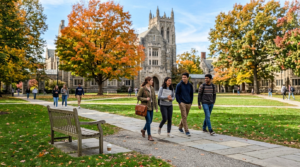
Bowdoin is distinctive within the NESCAC for the strength of its community-oriented culture and its beautiful coastal Maine setting. The college combines rigorous liberal arts academics with a strong emphasis on collaboration, student life, and outdoor experiences. Its location in Brunswick provides a traditional New England college-town environment while putting the Maine coast and the outdoors close at hand. Bowdoin also has no fraternities or sororities, which contributes to a campus social culture that is organized more broadly around the college community. For students considering other highly selective liberal arts colleges, Bowdoin can be particularly appealing to those who want academic intensity without a highly pre-professional atmosphere and who value a close-knit campus where traditions, friendships, athletics, and outdoor activities are central parts of the college experience.
What is Bowdoin looking for in your application?
The Bowdoin admissions office describes the traits they are seeking in applicants as follows:
Bowdoin seeks students who are bright and engaged inside and outside the classroom, and who demonstrate curiosity and a willingness to take intellectual risks.
Bowdoin is also a community of diverse backgrounds, beliefs, and experiences. For each entering class, we are interested in students who respect different views, opinions, and backgrounds, and who welcome the challenges associated with such diversity.
At a Glance: Bowdoin Application Essentials
| Component | Detail |
|---|---|
| Acceptance rate (Class of 2030) | 6.5% overall; lowest in college history |
| Applications received | 14,727 (record high) |
| Early Decision acceptance rate | 13.1% (301 admitted of 2,301 ED applicants) |
| Application platforms | Common Application or Coalition on Scoir |
| Testing policy | Test-optional since 1969 |
| Optional supplement essays | Up to two, 250 words each (The Offer of the College; navigating difference) |
| Early Decision I deadline | November 15, 2026 |
| Early Decision II deadline | January 5, 2027 |
| Regular Decision deadline | January 5, 2027 (financial aid due February 1) |
| Transfer deadline | March 3 |
| Interview | Not required, but strongly encouraged |
Why Does Bowdoin’s Application Process Deserve Its Own Strategy?
Bowdoin sits inside the NESCAC, the New England Small College Athletic Association, alongside ten other highly selective liberal arts institutions. The NESCAC is technically a Division III athletic conference, but when people talk about it, they are really referring to eleven highly selective, prestigious, generally liberal arts programs that are sometimes called the “little Ivies.” There are many reasons to add NESCAC schools to your college list, including smaller class sizes and an emphasis on undergraduate education. The eleven schools in the conference are Amherst, Bates, Bowdoin, Colby, Connecticut College, Hamilton, Middlebury, Trinity College, Tufts, Wesleyan, and Williams.
That identity matters because it signals what Bowdoin optimizes for: small classes, deep faculty relationships, and an undergraduate-only focus. It also means Bowdoin competes directly with ten near-identical peers for the same applicants, which is why differentiation in the essays carries so much weight.
A common misunderstanding among families is that Bowdoin’s academic reputation is generic liberal arts strength. In practice, Bowdoin is known for its research opportunities, and in particular has its own coastal studies center on Orr’s Island, off the coast of Maine, which makes it a strong option for students interested in marine science or marine biology. Applicants who ignore this and write about Bowdoin only in terms of “small class sizes” and “beautiful campus” are leaving one of the college’s most distinctive assets on the table.
Another misunderstanding is treating test-optional as a loophole rather than a genuine institutional value. Because Bowdoin was the first test-optional college in the country, starting in 1969, and 46% of the Class of 2030 chose not to submit test scores, the admissions committee has more than five decades of practice reading applications holistically without test scores as an anchor. That changes how much weight essays, transcripts, and recommendations carry relative to peer schools that adopted test-optional policies only recently.
What Are Bowdoin’s Application Requirements and Deadlines?
Bowdoin accepts the Common App or the Coalition on Scoir. Its process runs on three rounds: Early Decision I, Early Decision II, and Regular Decision. For the 2026-27 admissions cycle, Early Decision I and its financial aid application are due November 15, 2026, and Early Decision II and its financial aid application are due January 5, 2027. Regular Decision admissions materials are also due January 5, 2027, with the financial aid application due slightly later, on February 1.
The table below summarizes the core components every applicant needs to track.
| Component | Requirement | Notes |
|---|---|---|
| Application platform | Common Application or Coalition on Scoir | Bowdoin does not use its own separate application; both platforms are treated equally |
| Early Decision I deadline | November 15, 2026 | Binding; admissions and financial aid application both due |
| Early Decision II deadline | January 5, 2027 | Binding; admissions and financial aid application both due |
| Regular Decision deadline | January 5, 2027 (admissions); February 1 (financial aid) | Not binding |
| Standardized testing | Optional | Applicants choose which scores, if any, to submit; test choice can be changed up to the application deadline |
| Interview | Optional but strongly recommended | Available with alumni, current students, or admissions staff |
| Optional supplemental essays | Up to two, 250 words each | Not required, but the vast majority of competitive applicants complete both |
Two details here are easy to miss. First, the testing choice is not locked in at the start. Applicants can select some test types and not others, and they have until the application deadline to change their test-optional choice. If a student realizes they need to change something about their testing status, they should do so before final submission.
Second, the interview is optional, but Bowdoin’s admissions office strongly encourages it. Bowdoin offers virtual and in-person interviews with admissions staff, current students, and alumni volunteers, generally available from September through early December. Alumni interview requests carry their own deadlines that shift somewhat from year to year, with Early Decision I requests typically due in the weeks before the November 15 deadline and Early Decision II/Regular Decision requests generally due around December 1. Because these dates can move, applicants should confirm the current cycle’s exact deadlines on Bowdoin’s admissions site before assuming a specific date. In a process where the acceptance rate sits under 7%, skipping a component the college itself recommends is rarely the right call unless scheduling makes it impossible.
After a student submits their application, they also have the option to submit a short video directly to their Bowdoin portal that allows the admission office to get know the student beyond the traditional application.
What Does Bowdoin’s Admitted Class Actually Look Like?
Numbers ground strategy. For the Class of 2030, Bowdoin received a record 14,727 applications, a 4.9% increase over the prior cycle, and admitted 962 students across all rounds, producing a 6.5% overall acceptance rate, the lowest in the college’s history and down from 6.8% for the Class of 2029. The admitted class breaks down into 301 students offered admission across the two Early Decision rounds, 28 students matched through the QuestBridge National College Match, and 633 students offered admission through Regular Decision, including students deferred from the early rounds. The entering class ultimately enrolled 557 students, a yield rate of 58%.
Early Decision continued to outperform the overall pool, though the gap narrowed slightly this cycle: Bowdoin received 2,301 Early Decision applications and admitted 301, an Early Decision acceptance rate of about 13.1%, down from 14.8% the previous year but still roughly double the overall rate. This gap is exactly why early decision strategy deserves careful thought rather than a default “apply everywhere early” approach. Early decision can be a useful tool, but only when deployed strategically, because it does not guarantee improved odds for every applicant. It shifts probability, not certainty, and the shift only favors a student when the rest of the application, and the fit with the institution, is genuinely strong. A binding commitment to a poor-fit school is not a strategy; it is a gamble with a five-figure opportunity cost. Families weighing whether the ED advantage is real for their student’s profile can find a fuller breakdown of the actual statistical impact of applying early decision here.
What Are Bowdoin’s Supplemental Essay Requirements?
Bowdoin offers two prompts, each capped at 250 words, that are technically optional. The first asks applicants to select a line from “The Offer of the College,” a passage written by Bowdoin’s seventh president in 1906, and reflect on what it means to them. The second is a diversity-and-inclusion prompt: Bowdoin states that only through building a more diverse and inclusive campus community will it best prepare graduates to be contributing and useful citizens of the world.
Nothing marked “optional” in a process admitting under 7% of applicants should be treated as skippable. Both 250-word prompts give the admissions committee material it cannot get anywhere else in the application, and nearly all competitive applicants complete both. Applicants who try to summarize an entire personal history in 250 words end up saying nothing specific; applicants who narrow to one concrete moment or idea use the space far more effectively.
How Should You Approach the Offer of the College Essay?
The Offer of the College is a foundational passage in Bowdoin’s institutional identity, and the essay asks students to select a single line and explain why it resonates. This is not a rhetorical-analysis exercise. Admissions readers are not looking for literary interpretation; they want a genuine connection between the line chosen and the applicant’s actual life or interests.
For example, a student interested in marine biology has an unusually strong, specific hook available in the line about counting “Nature a familiar acquaintance.” Bowdoin’s own coastal studies center on Orr’s Island is a concrete, differentiated resource that few peer NESCAC schools can match, and referencing it credibly, with detail that shows research rather than a school-name mention, signals genuine fit rather than a copy-pasted “why Bowdoin” paragraph. Students without a marine-science hook should look for whichever line in the Offer maps most directly onto something they have actually done, not something they think sounds impressive.
How Should You Approach the Optional Diversity Essay?
For the diversity-and-inclusion prompt, the strongest responses come from students who have a real story of navigating difference, whether cultural, socioeconomic, ideological, or experiential, and who can articulate what they learned and how it will shape how they engage with Bowdoin’s community. Summarizing the experience briefly and spending most of the 250 words on reflection, rather than narrative detail, produces a stronger essay given the tight word count. This is not a box-checking diversity statement; it is a specific institutional value that admissions readers are trained to evaluate against, and generic answers about “valuing different perspectives” without a concrete personal example tend to read as hollow against a prompt this direct.
Why Does Authenticity Beat Optimization in the Essay Itself?
Admissions officers reading thousands of applications a cycle are not looking for a student to reverse-engineer what the committee wants to hear. They already have the transcript, the test scores if submitted, and the activity list. What they want from the essay, and from both optional supplements, is a sense of who the applicant actually is. Trying to gamify the response is the wrong approach; the more effective path is figuring out who the student is going to be in college and writing from that place authentically.
This matters even more at a school like Bowdoin, where the admissions committee reads through the lens of “The Offer of the College,” a long-standing institutional statement about the kind of intellectual and personal life the college hopes its students will build. A response that name-drops the coastal studies center or the NESCAC athletic culture without a genuine, specific connection to the student’s actual interests will not carry the same weight as one grounded in real experience, even if the real experience seems small.
What Is a Realistic Timeline for a Bowdoin Applicant?
Families often ask when to start building toward a Bowdoin-caliber application. The honest answer depends on grade level, but the framework holds across selective liberal arts admissions generally.
In ninth and tenth grade, the focus should be on keeping doors open: trying new activities, exploring academic interests without the pressure of college branding, and discovering what a student is authentically drawn to. By eleventh grade, it becomes appropriate to focus that exploration into activities and academic interests that support a college application, and to start discussing what makes colleges similar to and different from each other, including what a small rural liberal arts campus like Bowdoin offers compared to a mid-size or urban alternative. The goal by the end of junior year is a balanced college list built from real research and campus visits (Bowdoin does track demonstrated interest), with the bulk of application work, including the optional supplements, completed over the summer before senior year so the fall can focus on academics and refinement rather than a first draft under deadline pressure.
What Mistakes Do Applicants Commonly Make with Bowdoin?
Treating the optional interview as unimportant. Bowdoin’s admissions office actively schedules alumni interviews across a defined window each cycle, which signals that the college values the additional data point even though it does not require it. Skipping it without a real scheduling conflict removes a chance to demonstrate interest and personality that the essay word limits do not allow.
Skipping the two “optional” 250-word essays. With Bowdoin’s genuinely distinctive assets, like its coastal studies center, leaving either supplement blank, or filling it with a generic response that could be copy-pasted into a Williams or Amherst application, signals low research effort to a committee reading thousands of similar files.
Misjudging early decision as a guaranteed advantage. The early rounds produced roughly a 13.1% acceptance rate against a 6.5% overall rate for the Class of 2030, a meaningful gap even though it narrowed slightly from the year before, but applying early only helps a student whose application is genuinely strong and whose fit with Bowdoin specifically, not just NESCAC generally, is real. Applying early to the wrong school forecloses better-fit options without improving odds.
Getting the Details Right Is the Whole Game
Bowdoin’s application does not reward volume or generic polish; it rewards precision. Two 250-word supplements that are technically optional but functionally essential, an interview the college clearly values, and a testing policy the applicant can adjust until the deadline all point to the same conclusion: every choice in a Bowdoin application should be deliberate, not default. The main personal statement still runs through the Common App or Coalition platform, so it is worth reviewing general guidance on the Common App essay prompts before drafting Bowdoin’s shorter, more targeted supplements. The students who succeed here are the ones who can connect something specific about themselves, whether it is a genuine pull toward marine science, a real story about navigating difference, or a documented reason for choosing early decision, to something specific about Bowdoin.
If your student is building a college list that includes Bowdoin or other NESCAC schools and wants a strategy built around their actual profile rather than a generic template, our counselors work through exactly this kind of school-specific essay and timeline planning every admissions cycle. Reach out to Great College Advice to talk through where Bowdoin fits on your student’s list and how to approach its short, high-stakes supplemental essays with the specificity this process demands.
Frequently Asked Questions About Applying to Bowdoin College
Is Bowdoin’s supplemental essay required? The two 250-word prompts, one on The Offer of the College and one on navigating difference, are listed as optional, but nearly all competitive applicants complete both.
Does Bowdoin require standardized test scores? No. Bowdoin has been test-optional since 1969, the first college in the country to adopt that policy. Applicants can choose which scores, if any, to submit, and can change that choice up until the application deadline.
What is Bowdoin’s acceptance rate? Bowdoin admitted 6.5% of applicants to the Class of 2030, its lowest rate on record, out of 14,727 applications, the largest applicant pool in the college’s history. The Early Decision rate was notably higher, at about 13.1%, based on 301 admits out of 2,301 Early Decision applications.
Is applying Early Decision to Bowdoin a good strategy? It can be, but only for a student whose fit with Bowdoin specifically is genuine and whose application is already competitive. The Early Decision acceptance rate runs roughly double the overall rate, but a binding commitment to the wrong school forecloses better options without improving actual admission chances.