Skip to content

Knox College sits on a stage that once held Abraham Lincoln and Stephen Douglas, and it has never really left it. The small liberal arts college in Galesburg, Illinois, was built on the premise that education and public argument are inseparable — that a classroom is only as good as the debates it produces, and that ideas are meant to be tested in the open. For families evaluating whether Knox belongs on a student’s list, the useful question isn’t “what kind of liberal arts school is this?” but “what does it mean to attend a college whose founding DNA is dissent?”
That distinction matters because Knox’s progressive identity isn’t a marketing overlay. It traces to a specific founding purpose, a specific historical event, and a specific set of institutional structures that still shape daily life on campus. Students who thrive at Knox usually want to argue, organize, and build something rather than simply absorb a curriculum — which is exactly why a class visit tells you more than a tour ever will. (Our guide on how to sit in on a college class walks through how to arrange one.)
This piece traces that identity from its 1837 origins, through the Lincoln-Douglas debate of 1858, to the sustainability initiatives, interdisciplinary majors, and student-led governance that define Knox today — so families get a concrete picture of what “progressive” actually means here, not as a slogan but as a set of practices a student will live inside for four years.
Knox’s History Is the Operating System, Not a Footnote
Most colleges have a founding story that gets a paragraph in the viewbook and then disappears into campus lore. Knox is different: its founding purpose and its current culture are the same purpose, expressed in different centuries.
Knox was founded in 1837 by Presbyterian and Congregationalist abolitionists who had migrated from upstate New York and New England, and Galesburg was built around it as a planned community with anti-slavery conviction written into its charter (a founding Britannica also documents). This wasn’t a college that happened to have a few abolitionist faculty; the town and the college were a single, explicitly political project from day one.
That conviction wasn’t theoretical. In 1843, the college’s founder and other Galesburg abolitionists were indicted in Knox County court for aiding fugitive slaves, and the founders are documented as having played a central role in guiding and transporting people through Illinois to freedom. Galesburg’s reputation as a genuine sanctuary town was unusual even among abolitionist communities. Knox carries that history forward institutionally today, holding a “Freedom Station” designation from the National Underground Railroad Freedom Center — part of a nationwide network recognizing sites with documented Underground Railroad activity.
The Debate That Made Public Argument a Tradition
If the abolitionist founding gave Knox its convictions, the fifth Lincoln-Douglas debate gave it its method. On October 7, 1858, the site mattered precisely because of what the town already stood for: Lincoln knew Galesburg as an abolitionist town that harbored fugitives, and it was in front of that audience that he first spoke at length about the immorality of slavery. Because Knox’s and Galesburg’s founders were already committed anti-slavery advocates, the campus was a fitting place for Lincoln to press the moral case against Douglas’s position.
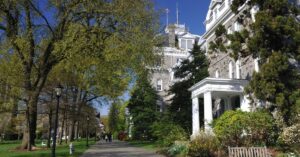
That single afternoon set a template Knox has never abandoned — a campus where difficult, high-stakes public argument is the point of academic life, not an interruption to it. The debate site remains marked today, overlooking the east side of Old Main, functioning less as a historical plaque than as a daily reminder of what the institution expects from the people who walk past it.
This is the frame families should use when they hear Knox called progressive. It isn’t a college that recently discovered social-justice language; it’s one whose founders were prosecuted for direct action, whose most famous campus event was a national debate over the morality of slavery, and whose subsequent 180 years have been an extended exercise in keeping that tradition of consequential argument alive.
How Progressive Identity Shows Up in the Curriculum Today
A founding story only matters if it survives contact with the modern course catalog. At Knox, the abolitionist and debate legacy translates into three present-day structures: interdisciplinary majors, sustainability programs with measurable outcomes, and governance systems that put students in charge of enforcing their own standards.
Interdisciplinary Majors Built to Cross Silos
Knox’s academic structure resists narrow specialization. The Environmental Studies major is explicit about this: because the field is interdisciplinary, graduates build skills in science alongside policy and social analysis, and the capstone sequence requires students to develop their own research question and methodology before carrying out independent research under a faculty mentor. International Studies follows the same logic from another angle, integrating social science and history with practical mastery of foreign languages and cultures. Even Biochemistry is framed as a discipline that lives at an intersection rather than inside a single department, with hands-on lab work built into nearly every course.
The instinct is the same one that produced the Lincoln-Douglas debate: refuse to let disciplinary or institutional boundaries dictate which questions are worth asking. Knox asks students to build a research question, then pull whatever intellectual tools they need to answer it — regardless of which department those tools belong to.
Sustainability as Applied Progressive Politics
Where the 19th-century version of Knox’s activism was abolition, the 21st-century version includes sustainability infrastructure with audited outcomes rather than aspirational language. The Princeton Review recognized this directly, naming Knox one of 422 schools in the 2022 edition of its Guide to Green Colleges.
That recognition reflects operating programs, not a single green initiative. Campus includes a Bike Shop that loans bikes to students for free and a volunteer-led Share Shop that turns donated clothes, books, and household goods into a free thrift store, alongside a food-share pantry addressing student food security. A partnership with two Peoria-area waste-management companies produced measurable results: over roughly two and a half years, it kept more than 56,000 pounds of waste out of landfills. The college’s environmental work extends beyond the main campus, anchored by the 700-acre Green Oaks Biological Field Station.
| Era / Domain | Concrete Expression | Institutional Mechanism |
|---|---|---|
| 1837 Founding | Abolitionist charter and town-college partnership | Founders indicted for aiding fugitive slaves in Knox County court |
| 1858 Debate | Public reckoning with the morality of slavery | Lincoln-Douglas debate held on Knox’s Old Main campus |
| Present-day Curriculum | Cross-disciplinary majors (Environmental Studies, International Studies, Biochemistry) | Student-designed capstone research questions across departments |
| Present-day Sustainability | Green Colleges recognition, waste diversion, food security | Office of Sustainability, Bike Shop, Share Shop, Green Oaks Field Station |
| Present-day Governance | Student-authored, student-enforced academic integrity system | Honor Code originated by the student body in 1951, enforced by a student-majority Honor Board |
Student Self-Governance: The Honor Code
The clearest evidence that Knox treats students as agents of institutional change, rather than recipients of institutional rules, is its Honor Code. This is not a policy handed down by administrators. It was initiated by the student body in 1951 and still defines the college’s academic culture, with every student and faculty member sharing responsibility for defending academic integrity. The enforcement mechanism reinforces the point: the Honor Board is majority-student by design — eleven students (three seniors, four juniors, four sophomores) alongside three faculty members. Students didn’t just petition for this system; they built it and they run it.
That posture extends to activism more broadly. When a wave of student walkouts and organizing spread across the country after a national tragedy, Knox’s Admission Office didn’t treat student activism as a liability to manage — it issued explicit support, framing itself as a learning community committed to free expression and civic engagement. That stance is consistent with the 1837 founding logic: an institution that expects its members to act on their convictions, and builds structures to support them when they do.
What This Means for a Student’s Four Years
For a prospective student, Knox’s progressive identity isn’t an abstraction to admire from a distance. It shapes everyday reality. Upper-level coursework across several majors is built around student-generated questions rather than fixed answers — a Knox student should expect to be asked, repeatedly, “what do you think the actual problem is?” Activism and civic engagement are treated as legitimate parts of a student’s record rather than distractions from it, so a student who arrives already engaged in advocacy will find a culture built to support that instinct, not merely tolerate it. Governance is a skill students practice: serving on the Honor Board, or simply living under a code the student body wrote and enforces, means every student gets direct exposure to community self-regulation before graduating. And sustainability is operational — the waste-diversion partnerships, Green Oaks, and the Bike and Share Shops are functioning systems a student can join in their first term. Because the campus is deeply integrated with Galesburg, students rarely feel the need to leave on weekends, avoiding the “suitcase school” pattern where social life evaporates every Friday.
A few common misreadings are worth heading off. “Progressive” here doesn’t mean politically homogeneous: the pattern Knox’s founding conviction established is a culture of debate and direct engagement, not ideological uniformity — the Lincoln-Douglas debate was, after all, a contest between opposing national figures, held on Knox’s ground precisely because the town could handle a real argument. Nor is the abolitionist history a closed chapter; the Freedom Station designation and the preserved, interpreted debate site are infrastructure the college keeps investing in. And it’s easy to fixate on history and curriculum while missing the strongest current proof point — an Honor Code written by students in 1951 and still enforced by a student-majority board.
Is Knox the Right Fit for You?
Knox’s progressive reputation rests on a continuous line from a specific founding act (an abolitionist college built inside an abolitionist town), through a specific historical moment (the fifth Lincoln-Douglas debate, hosted on campus in 1858), to a specific set of present-day structures: interdisciplinary majors that force cross-departmental thinking, a sustainability program with verified outcomes, and an Honor Code students wrote and still enforce. This is a college where the founding purpose and the current student experience are versions of the same idea, a century and a half apart.
For families building a college list around fit rather than prestige, Knox is worth serious consideration if a student wants a campus organized around debate, direct civic action, and self-governance rather than passive credentialing. As part of the Colleges That Change Lives (CTCL) consortium, a ‘Knox education is not something you sit and watch — it’s something you do.’ (Learn more about CTCL schools by finding a college fair in your area.)
Our team at Great College Advice helps students determine whether a school’s stated identity actually matches how a specific student learns, argues, and wants to spend four years. If you’re weighing whether a mission-driven school like Knox fits your student’s goals, schedule a free consultation with Great College Advice to map out how it compares against the rest of your list.