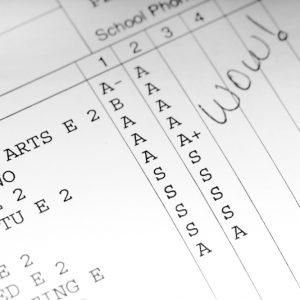
It is time to declare a moratorium on class rank obsession.
One of the most popular posts on this blog explains the difference between weighted and unweighted GPAs — and the phenomenon of class rank. The comments never stop. Parents write in frustrated, confused, and sometimes furious, convinced that a single decimal point or a slip from #3 to #7 in their child’s class will unravel an entire college application.
I recently heard from a parent whose daughter — a senior — had been sitting at the top of her class when the school quietly reversed a grading policy mid-application season. No formal notification. No clear explanation. Just a new transcript with a different rank. The parent was understandably upset and reached out for guidance before her appointment with the principal.
I responded at length, and I am reprinting a version of that response here because I suspect many families are carrying the same anxiety — and deserve a clear, calm answer.
What Is Weighted vs Unweighted GPA
GPA stands for grade point average. At its most basic, a school converts each letter grade into a number — typically A = 4, B = 3, C = 2, D = 1 — adds those numbers across all courses, and divides by the number of classes. That gives you a grade point average.
The complication is that not all classes carry the same academic weight. An A in a ceramics elective and an A in AP Physics C represent very different levels of intellectual challenge. Recognizing that gap is the entire purpose of the weighted GPA.
Sarah Farbman, senior admissions consultant at Great College Advice, explains it this way:
“A weighted GPA works by assigning more weight to harder courses. So if you get an A in AP Physics C, that might earn you a five rather than a four, so that when you add up all those scores and average them, you could actually get above a 4.0. That number tells us that this student is carrying a heavier course load. It is like how in the Olympics, athletes are rated not just on their execution of a trick, but also on its difficulty.”
— Sarah Farbman, Senior Admissions Consultant, Great College Advice
An unweighted GPA ignores course difficulty entirely. Every class is scored on the same 4.0 scale, regardless of whether the student is taking AP Calculus BC or a standard elective. Most high school transcripts show both figures, and most colleges want to see both — because together they tell a more complete story than either number alone.
How Much Do Colleges Actually Care About Class Rank?
Less than you think — and the trend is moving in the right direction.
According to data from the National Association for College Admission Counseling, admissions officers as a group are paying less attention to class rank than they did a decade ago. Even among the most selective universities, only about 32% report giving class rank “considerable importance.” The rest treat it as context at best.
Why the shift? Partly because many high schools have stopped reporting rank altogether. Some provide only a general range — top 10%, top quarter, median — while others leave the question blank on school profiles. Admissions officers have adapted. They have developed additional tools to evaluate academic rigor and performance.
The bigger picture: at the most selective schools, what matters is whether a student is broadly in the top 10% of the graduating class. Admissions officers think in percentile bands — top 5%, top 10%, top 25% — not in raw ordinal numbers. Whether your child is ranked #8 or #18 in a class of 200 is, in almost every case, a distinction without a meaningful difference.
Back to the Parents’ Question: What Do You Do When the School Changes the Rules?
The parent who wrote to me was facing a specific, infuriating situation: the school had assigned a 4.3 for A+ grades, published that policy, and then reversed it after complaints from other parents whose children’s ranks had dropped. The result was a transcript that no longer matched the September communication.
Here is my practical advice for any family in a similar situation:
1. Document everything.
Keep a copy of every transcript, school handbook excerpt, and email you have received. If the school published a policy in writing — in a handbook, on a portal, in any official communication — that document has value. Bring it to your meeting with the principal.
2. Request clarity in writing.
Before the appointment, send a brief email to the school requesting written confirmation of which GPA and class rank will appear on the official transcript sent to colleges. This creates a record and signals that you expect a formal, documented answer.
3. Ask about sending both versions — but do so strategically.
In most cases, asking a school to send two versions of a transcript (one weighted, one unweighted) is a reasonable request, especially if both figures reflect legitimate calculations. However, a school is unlikely to send competing rank figures to colleges. Focus your energy on clarifying what the official transcript will say—and getting that commitment in writing before applications go out.
4. Consider the school counselor’s recommendation letter.
If the grading policy confusion is genuinely unusual and documented, your school counselor has an appropriate place to address it: the counselor recommendation and school profile that accompany every transcript. A brief, factual note explaining the policy transition is entirely within the counselor’s normal scope. Admissions officers read these notes. This is a more effective approach than submitting alternative transcripts.
5. Perspective check: admissions officers are not fooled by rank alone.
A student with excellent grades in rigorous courses, strong test scores (where applicable), and a compelling application is not going to be derailed by a class rank anomaly that is clearly the result of an administrative hiccup. Admissions officers are experienced readers. They contextualize everything — including rank — against the full school profile.
Does Unweighted Grading Logically Conflict with Class Rank?
This is a genuinely interesting question, and the answer is: yes, there is an inherent tension.
When a school uses an unweighted GPA — treating all classes equally — and then ranks students against each other, it creates a system that inadvertently penalizes students who take more challenging courses. A student with a 3.9 unweighted GPA earned in AP Biology, AP US History, and Honors English is ranked identically to a student with a 3.9 earned in less demanding coursework. The rank number tells you nothing about the rigor behind it.
This is one of the reasons many high schools have moved away from ranking entirely. It is also why colleges rely heavily on the
course rigor reflected in a transcript — not just a summary GPA or rank — in their evaluations.
If a school insists on ranking students but uses only unweighted grades, the honest answer is that the ranking is an incomplete measure. Colleges know this. Their admissions readers are trained to look past it.
What Colleges Are Actually Looking For
Sarah Farbman puts the college perspective plainly:
“When colleges are evaluating GPA, they are not looking at the number in isolation. They are looking at where that number puts you within your high school class. What’s actually helpful is looking at the percentile — what percentage of the applicant pool was in the top 10%, 25%, or 50%. That is really how colleges are going to look at your GPA, and it is how you should look at your GPA too.”
— Sarah Farbman, Senior Admissions Consultant, Great College Advice
In other words, a 3.8 GPA at a highly competitive school where the median is 4.1 tells a very different story than a 3.8 at a school where the median is 3.5. Admissions officers understand this. They read school profiles. They have historical data on each high school in their territory. They have seen enough transcripts to know exactly what a given number means in context.
The GCA Family Handbook frames it clearly: “The GPA is an indicator of a student’s relative performance within their school. It is a very unreliable indicator of how a student compares to peers at other schools, in other states, or even other countries.” Admissions officers — fortunately — have very good systems for making these comparisons across the extraordinary diversity of American high schools.
Practical Takeaways for Parents
If you are a parent navigating the GPA and class rank conversation right now, here is what to hold onto:
- Admissions readers think in percentile bands, not ordinal ranks. Being in the top 10% of a class matters far more than being #4 or #12.
- Weighted GPA rewards rigor. A student with a 4.2 weighted GPA, earned in AP and honors courses, is telling a stronger academic story than the raw number suggests.
- Many schools don’t rank at all. If your child’s school does not report rank, that will not hurt the application — colleges have adapted.
- Administrative errors at schools happen. Document them, address them through official channels, and trust that a well-constructed application speaks louder than a clerical inconsistency.
- Course rigor is the signal colleges most want to see. The key is finding the right balance between maintaining good grades while taking these harder classes. Challenging coursework in the right areas — pursued genuinely, not just for strategic optics — is what admissions committees remember. For a deeper look at how to think about this from ninth grade onward, see our guide on college admissions tips for 9th grade and our overview of the college admissions lifecycle through high school.
Navigate Admissions with Great College Advice
Class rank is a blunt instrument, and the college admissions world increasingly knows it. Whether your child is ranked first or fifteenth, the question admissions officers are really asking is: Did this student challenge themselves academically? Did they perform at a high level? Are they prepared for rigorous college coursework?
A rank number is one data point among dozens. A compelling application — with strong grades in demanding courses, genuine extracurricular depth, and thoughtful essays — is what earns admission. Not a rank.
If your family is navigating GPA questions, course selection strategy, or the college list-building process, the counselors at Great College Advice have helped thousands of families through exactly this.
Reach out to schedule a consultation Skip to content